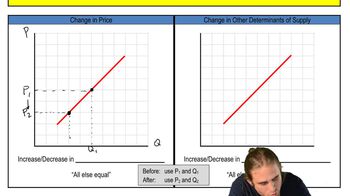
What does 'movement along a supply curve' refer to in microeconomics?
Movement along a supply curve refers to changes in the quantity supplied resulting from changes in the price of the good, with all other factors held constant.
In moving along a supply curve, which of the following is not held constant: price, technology, input costs, or number of sellers?
Price is not held constant; it changes and causes movement along the supply curve, while other factors like technology, input costs, and number of sellers are held constant.
On a supply curve diagram, what does movement from points a to b to c illustrate?
Movement from points a to b to c on a supply curve illustrates changes in quantity supplied due to changes in price, with all other determinants of supply held constant.
What happens to the quantity supplied when the price of a product decreases, according to the law of supply?
When the price of a product decreases, the quantity supplied decreases, resulting in movement to the left along the supply curve.
How is a shift in the supply curve visually represented on a graph?
A shift in the supply curve is shown by drawing a new line parallel to the original supply curve, either to the right for an increase or to the left for a decrease in supply.
What does the principle of ceteris paribus mean when analyzing changes in supply?
Ceteris paribus means holding all other factors constant except the one being analyzed, allowing us to isolate the effect of a single variable on supply.
If a factor other than price changes, what effect does this have on the supply curve?
A change in a factor other than price causes the entire supply curve to shift, indicating a change in supply rather than just quantity supplied.
When drawing a new supply curve due to a shift, what does a rightward shift indicate?
A rightward shift of the supply curve indicates an increase in supply, meaning more quantity is supplied at every price.
What is the difference between a change in supply and a change in quantity supplied?
A change in supply involves shifting the entire supply curve, while a change in quantity supplied is movement along the existing curve due to a price change.
Why do we not draw a new supply curve when only the price changes?
We do not draw a new supply curve because price is already a variable on the graph; only non-price factors cause the curve to shift.