What types of government systems provide payments or food to the poor?
A government system for giving payments or food to the poor includes welfare programs (which provide cash payments) and in-kind transfers (such as food stamps and free healthcare), both designed to support low-income individuals.
How do minimum wage laws function as a policy to reduce poverty?
Minimum wage laws set a price floor for wages, ensuring workers earn at least a minimum amount, which helps increase the income of low-wage workers.
What is the main difference between welfare programs and in-kind transfers?
Welfare programs provide cash payments to supplement income, while in-kind transfers offer non-cash benefits like food stamps or free healthcare.
How does a negative income tax work for low-income families?
A negative income tax provides subsidies to low-income families, so instead of paying taxes, they receive payments from the government based on their income level.
What is the earned income tax credit and how does it relate to negative income tax?
The earned income tax credit is a U.S. program that acts similarly to a negative income tax by giving cash subsidies to low-income working families.
Why might anti-poverty programs create a disincentive to work?
If government benefits decrease as income rises, individuals may prefer not to work or work less to retain those benefits, reducing their incentive to earn more.
What is an example of an in-kind transfer provided by the government?
Examples include food stamps, which are vouchers for food purchases, and Medicaid, which provides free healthcare services to low-income individuals.
How can guaranteed income programs potentially affect work effort in the economy?
Guaranteed income programs may discourage people from working if they receive the same amount of money whether they work or not, leading to inefficiency.
What issue did some families face with Obamacare subsidies as their income increased?
As families earned more, they lost government healthcare subsidies, so their increased income was offset by higher healthcare costs, leaving their standard of living unchanged.
How are tax payments calculated in a simple negative income tax system described in the transcript?
Tax payments are calculated as one-fourth of a family's income minus a fixed amount (e.g., \$10,000), resulting in subsidies for low-income families and taxes for higher-income families.
 Back
Back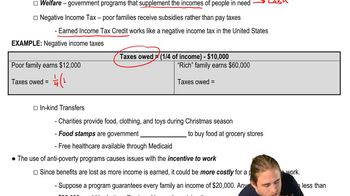
 06:15
06:15