What is likely to occur if there is a price increase for a good that exhibits elastic demand?
A price increase for a good with elastic demand will cause a significant decrease in quantity demanded, leading to a decrease in total revenue.
Which good is likely to have the most price elastic demand among wheat, gasoline, and life-saving drugs?
Wheat is likely to have the most price elastic demand because it has many close substitutes and is often sold in perfectly competitive markets.
What does price elasticity of demand measure?
Price elasticity of demand measures how much quantity demanded changes in response to a change in price.
Suppose the value of the price elasticity of demand is -3. What does this mean?
A price elasticity of demand of -3 means that a 1% increase in price will lead to a 3% decrease in quantity demanded; demand is elastic.
Refer to the graph above. Which demand curve is relatively most elastic between prices P1 and P2?
The demand curve that is flatter (more horizontal) between P1 and P2 is relatively most elastic.
Refer to the graphs above. Which one shows a perfectly elastic demand?
The graph with a horizontal demand curve represents perfectly elastic demand.
What does an elastic demand curve indicate about quantity demanded when price changes?
An elastic demand curve does not show little change in quantity demanded when price changes; instead, quantity demanded changes significantly.
In which price range of the accompanying demand schedule is demand elastic?
Demand is elastic in the price range where a small change in price leads to a large change in quantity demanded.
Why does demand generally become more elastic over time?
Demand becomes more elastic over time because consumers have more time to find substitutes and adjust their behavior.
What happens to total revenue when the price increases for a good with elastic demand?
When price increases for a good with elastic demand, total revenue decreases.
When demand is elastic and marginal revenue is positive, total revenue must be
Increasing, because with elastic demand, lowering price increases total revenue.
The price elasticity of demand measures the:
Responsiveness of quantity demanded to changes in price.
The price elasticity of demand coefficient measures
The percentage change in quantity demanded divided by the percentage change in price.
A luxury cruise will exhibit a relatively price elasticity of demand.
A luxury cruise will exhibit relatively elastic demand because it is a non-essential good with many substitutes.
Refer to Figure 5-1. Between point A and point B, price elasticity of demand is equal to
The percentage change in quantity demanded divided by the percentage change in price between points A and B.
One of the most important concepts in marketing is the price elasticity of demand, which is the
Measure of how sensitive consumers are to price changes for a product.
Demand can be said to be inelastic when:
A change in price leads to a relatively small change in quantity demanded.
Label demand as elastic, unit elastic, or inelastic based on the shape of the demand curve.
Elastic demand is shown by a flatter (horizontal) curve, unit elastic by a curve where percentage changes in price and quantity are equal, and inelastic by a steeper (vertical) curve.
 Back
Back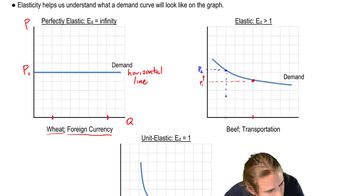
 11:34
11:34