What is the maximum utilization a resource can achieve in terms of efficiency?
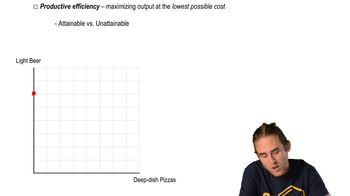
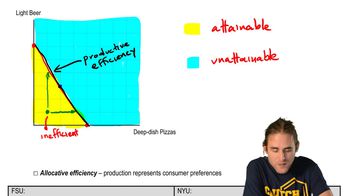
The maximum utilization is achieved when resources are used to their fullest potential, producing on the production possibilities frontier, which represents productive efficiency.
How should goods and services be produced to achieve efficiency?
Goods and services should be produced in a way that maximizes output at the lowest possible cost, reflecting productive efficiency.
What causes allocative inefficiency?
Producing a mix of goods and services that does not match consumer preferences leads to allocative inefficiency.
What action furthers the economic goal of efficiency?
Allocating resources to produce the mix of goods and services most desired by consumers furthers economic efficiency.
What is the virtue of efficiency in economics?
Efficiency ensures society gets the maximum benefit from its scarce resources.
What is characteristic of a lean production layout?
A lean production layout minimizes waste by eliminating anything not essential to the product or process.
Which describes the fairness–efficiency trade-off in economics?
The fairness–efficiency trade-off refers to balancing the fair distribution of resources (equality) with maximizing output (efficiency).
When is utilization of a resource maximized?
Utilization is maximized when resources are used efficiently, producing on the production possibilities frontier.
What is the reason behind why monopolies are allocatively inefficient?
Monopolies are allocatively inefficient because they do not produce the mix of goods and services that matches consumer preferences, often restricting output and raising prices.
When is productive efficiency improved?
Productive efficiency is improved when output is increased without increasing costs, or when the same output is produced at a lower cost.
How are resources allocated efficiently in an economy?
Resources are allocated efficiently when they are used to produce the mix of goods and services most desired by consumers.
The optimal use of a resource takes place when which condition is met?
Optimal use occurs when resources are allocated to maximize total benefit, producing at the point of allocative efficiency.
Which scenario exemplifies the concept of efficiency versus effectiveness in time usage?
Completing a task quickly with minimal resources (efficiency) versus achieving the desired outcome regardless of resource use (effectiveness).
Efficiency is producing output at the lowest possible average total cost of production. True or false?
True. This describes productive efficiency.
Doing something at the lowest possible cost is known as what type of efficiency?
Productive efficiency.
A perfectly competitive industry is said to be efficient because:
It produces goods at the lowest possible cost and allocates resources according to consumer preferences.
The regulated price is allocatively efficient when:
It matches the price consumers are willing to pay with the cost of production, reflecting consumer preferences.
The oligopolistic industry is not allocatively efficient because:
It may restrict output and set prices above the level that matches consumer preferences, leading to a misallocation of resources.
What is an example of an allocational boundary in economics?
An allocational boundary is the point on the production possibilities curve where the mix of goods produced matches consumer preferences.
Are real-world efficiencies generally very high, in the 90 percent range?
No, real-world efficiencies are often lower due to factors like market imperfections and resource constraints.
What matters most in determining the efficient distribution of production over the world?
Consumer preferences and the ability to produce goods at the lowest cost matter most for efficient distribution.
The optimal allocation of resources occurs when:
Resources are used to produce the mix of goods and services most desired by society, achieving allocative efficiency.
In determining the optimal level of output, a firm should aim for the point where:
 Back
Back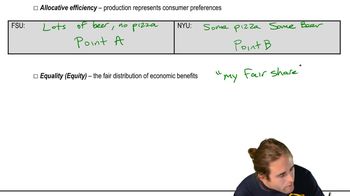
 01:17
01:17