Skip to main content
Microeconomics
My Course
Learn
Exam Prep
AI Tutor
Study Guides
Flashcards
Explore
Try the app
My Course
Learn
Exam Prep
AI Tutor
Study Guides
Flashcards
Explore
Try the app
Back
Allocative Efficiency, Productive Efficiency, and Equality quiz #2
You can tap to flip the card.
Allocative efficiency is achieved when firms produce goods and services:
You can tap to flip the card.
👆
Allocative efficiency is achieved when firms produce goods and services:
In quantities that reflect consumer preferences and maximize societal benefit.
Track progress
Control buttons has been changed to "navigation" mode.
1/10
Related flashcards
Related practice
Recommended videos
Allocative Efficiency, Productive Efficiency, and Equality quiz #1
Allocative Efficiency, Productive Efficiency, and Equality
39 Terms
Allocative Efficiency, Productive Efficiency, and Equality definitions
Allocative Efficiency, Productive Efficiency, and Equality
15 Terms
Allocative Efficiency, Productive Efficiency, and Equality
0. Basic Principles of Economics
10 problems
Topic
Positive and Normative Analysis
0. Basic Principles of Economics
8 problems
Topic
0. Basic Principles of Economics
13 topics
14 problems
Chapter
Guided course
01:17
Equality
5373
views
202
rank
Guided course
04:04
Efficiency and Productive Efficiency
8606
views
224
rank
Guided course
02:23
Allocative Efficiency
5574
views
133
rank
Terms in this set (10)
Hide definitions
Allocative efficiency is achieved when firms produce goods and services:
In quantities that reflect consumer preferences and maximize societal benefit.
In a lean environment, anything not essential to the product or process is viewed as what?
Waste.
What does productive efficiency mean in terms of resource use?
Productive efficiency means maximizing output from scarce resources at the lowest possible cost.
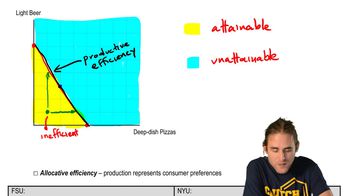
On a production possibilities curve, what do points inside the curve represent?
Points inside the curve represent inefficient production because more output could be achieved with the same resources.
What does the area outside the production possibilities curve indicate?
The area outside the curve is unattainable with current resources, meaning production at those levels is impossible.
How is the point of allocative efficiency determined for different groups?
Allocative efficiency is determined by consumer preferences, so different groups will have different points based on what they value most.
Why is allocative efficiency considered more subjective than productive efficiency?
Allocative efficiency depends on knowing and meeting consumer preferences, which can vary and are not always obvious.
What does equality focus on in economics?
Equality focuses on the fair distribution of economic benefits among members of society.
How does ethics relate to the concept of equality in economics?
Ethics is involved in equality because it raises questions about whether resource distribution is fair or just.
In what context does equality become more important in microeconomics?
Equality becomes more important when discussing policy making and government intervention in markets.
 BackBack
 01:17
01:17