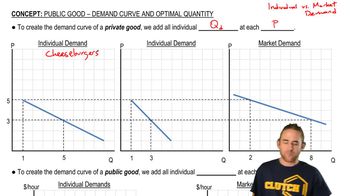
How are collective goods (public goods) different from private goods?
Collective goods are non-rival and non-excludable, meaning one person's use does not reduce availability for others and people cannot be prevented from using them. Private goods are rival and excludable.
What is an example of a public good?
National defense is an example of a public good.
Which is an example of a government monopoly in the United States?
The United States Postal Service is an example of a government monopoly.
Which is an example of a government monopoly in the United States?
The United States Postal Service is an example of a government monopoly.
What is an example of a good that is not a public good provided by the government?
A private swimming pool is not a public good provided by the government.
What is the purpose of NAFTA?
The purpose of NAFTA is to reduce trade barriers and increase economic cooperation between the United States, Canada, and Mexico.
What are the characteristics of public goods?
Public goods are non-rival and non-excludable.
What is an example of a pure public good?
Clean air is an example of a pure public good.
What is a disadvantage of government provision of a public good?
A disadvantage is the potential for inefficiency or overprovision due to lack of market signals.
Which answer is not an example of a merit good or service?
Cigarettes are not an example of a merit good or service.
What is an example of a natural trade barrier?
Geographic distance between countries is an example of a natural trade barrier.
What is true about public goods?
Public goods are available to all and one person's use does not diminish another's.
What is usually true about government-provided goods?
Government-provided goods are often non-rival and non-excludable.
Which of these is not a public good?
A cheeseburger is not a public good.
Why does a campground at a national park not necessarily count as a public good?
A campground can be rival and excludable if access is limited and fees are charged.
Which is an example of a public good that a consumer may want but not be able to obtain?
Clean air in a polluted city is a public good a consumer may want but not be able to obtain.
What is an example of a trading bloc?
The European Union is an example of a trading bloc.
What is an example of a good that is not a public good?
A private car is not an example of a public good.
Subsidized housing is an example of what?
Subsidized housing is an example of a merit good.
What demonstrates nonrivalry in consumption?
One person benefiting from national defense does not reduce the benefit for others.
Why do governments provide some goods and services in market economies?
Governments provide goods and services that markets would underprovide due to non-excludability and non-rivalry.
Social insurance programs have high levels of public support because
They provide broad benefits and reduce risks for many people.
Why are private companies unlikely to provide public goods?
Private companies are unlikely to provide public goods because they cannot easily exclude non-payers and cannot profit from them.
What is one of the benefits of increasing economic interdependence?
Increasing economic interdependence can lead to greater efficiency and access to a wider variety of goods.
The market demand for a public good can be determined by
Vertically summing the prices individuals are willing to pay at each quantity.
Consumption tax pays for things everyone gets to enjoy, like . . .
Consumption tax pays for public goods like national defense and public parks.
In a mixed market economy, property owned by the government
Is used to provide public goods and services.
A government provides national defense because it is a public good.
True. National defense is non-rival and non-excludable, making it a public good.
When economic benefits are distributed uniformly across society
It often results from the provision of public goods.
How are collective goods different from private goods?
Collective goods are non-rival and non-excludable, while private goods are rival and excludable.
One major difference between public goods and private goods is that
Public goods are non-rival and non-excludable; private goods are rival and excludable.
The provision of a public good generates a
Marginal social benefit equal to the sum of individual values placed on the good.
 Back
Back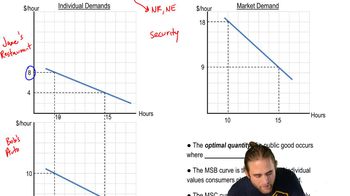
 08:18
08:18