Diversification is holding a large number of different investments to reduce risk by spreading out firm-specific risks.
What type of risk can be reduced through diversification?
Firm-specific risk can be reduced through diversification because it only affects individual firms.
What is market risk?
Market risk is the risk that affects the entire market, such as recessions or wars, and cannot be diversified away.
Why can't market risk be diversified away?
Market risk affects all investments simultaneously, so holding different assets does not eliminate this risk.
What is an example of firm-specific risk?
An example of firm-specific risk is a company losing customers or facing new competitors, which only impacts that particular firm.
Why do investors expect a higher rate of return from stocks compared to risk-free investments?
Investors expect a higher rate of return from stocks because they are taking on more risk compared to risk-free investments like US Treasury bills.
What is considered a risk-free investment?
US Treasury bills or notes are generally considered risk-free investments because they are backed by the US government.
How is the rate of return calculated?
The rate of return is calculated as the income earned from the investment divided by the price paid for it.
What are the two main sources of income from stocks?
The two main sources of income from stocks are dividends and capital gains.
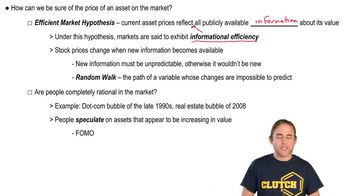
What does the efficient market hypothesis state?
The efficient market hypothesis states that stock prices reflect all publicly available information, making them informationally efficient.
Why are stock price movements considered unpredictable under the efficient market hypothesis?
Stock price movements are unpredictable because new information is, by nature, unpredictable and immediately reflected in prices.
What is meant by a 'random walk' in stock prices?
A 'random walk' means that stock prices move in an unpredictable pattern due to the constant arrival of new, unforeseen information.
How can irrational investor behavior affect market prices?
Irrational behavior, such as speculation and following trends, can inflate prices and create bubbles, deviating from true market values.
What is a market bubble?
A market bubble occurs when asset prices are driven up by speculation and irrational behavior, eventually leading to a sharp decline when the bubble bursts.
Why does the efficient market hypothesis not always hold true in real markets?
The efficient market hypothesis doesn't always hold because investors are not always rational and can be influenced by emotions and herd behavior.
 Back
Back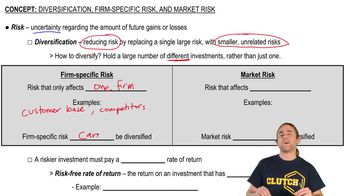
 05:40
05:40