Pearson+ LogoPearson+ Logo

Scarcity and Choice quiz #2 Flashcards

Scarcity and Choice quiz #2
Control buttons has been changed to "navigation" mode.
1/40
  • Other things held constant, what does scarcity imply?

    Scarcity implies choices must be made among competing uses.
  • What is the opportunity cost of product B?

    It is the value of the next best alternative forgone to produce product B.
  • Which of the following is true about scarcity?

    Scarcity is a universal condition affecting all societies.
  • Which of the following is not scarce according to the economic definition?

    Air (in most situations).
  • What does it mean to say that a resource is scarce?

    It means the resource is limited and cannot satisfy all wants.
  • Which of the following statements about scarcity is true?

    Scarcity requires people to make choices.
  • Which of the following describes scarcity?

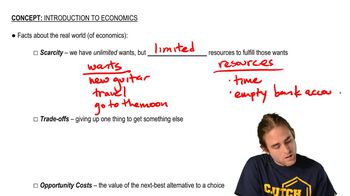
    Scarcity is the condition of having limited resources to meet unlimited wants.
  • Which of the following is not an example of scarcity?

    Unlimited supply of sunlight in a desert.
  • What is the difference between a shortage and a scarcity?

    Shortage is temporary; scarcity is a permanent condition.
  • Which of the following best describes scarcity?

    Scarcity is the gap between limited resources and unlimited wants.
  • Which of the following statements is not true about opportunity cost?

    Opportunity cost only applies to monetary decisions.
  • What factors into the opportunity cost for a decision?

    The value of the next best alternative forgone.
  • What will we never do in a world of scarcity?

    We will never satisfy all wants.
  • What is Paulie's opportunity cost of producing a cup of ice cream?

    It is the value of the next best alternative Paulie gives up to produce the ice cream.
  • Other things equal, what does scarcity require?

    Scarcity requires making choices and trade-offs.
  • Which statement explains the tradeoff between today's consumption and future consumption?

    Spending money today reduces what you can save and consume in the future.
  • Which demonstrates a scenario with no opportunity cost?

    A choice where no alternatives are given up (rare in economics).
  • What is the relationship between decisions and trade-offs?

    Every decision involves a trade-off because choosing one option means giving up another.
  • Which of these best describes an opportunity cost? A win-win, a loss, a chance, a trade-off

    A trade-off.
  • What is the opportunity cost of an investment?

    The potential returns from the next best alternative investment.
  • Which economic model reveals the variety of options for what to do with your scarce time?

    The production possibilities frontier (PPF).
  • Which of the following helps to avoid wasting resources on goals that cannot be accomplished?

    Evaluating opportunity costs and trade-offs.
  • Why is it important to evaluate trade-offs and opportunity costs when making choices?

    It helps ensure resources are used efficiently and the best possible outcome is achieved.
  • Why are resources for consumer consumption limited?

    Resources are limited due to scarcity.
  • Which statements accurately show the concept of scarcity? Check all that apply.

    Resources are limited; choices must be made; not all wants can be satisfied.
  • Which is true about scarcity?

    Scarcity affects everyone and requires choices.
  • Which statement about scarcity is true?

    Scarcity means not enough resources to satisfy all wants.
  • Which one of these represents an opportunity cost?

    Missing a concert to study for an exam.
  • Which of the following is an example of scarcity?

    Limited supply of clean drinking water.
  • What is the opportunity cost of not going to college?

    The education and potential higher earnings you forgo.
  • Which of the following statements is true about scarcity?

    Scarcity is a permanent condition in economics.
  • What is one of the risks involved in complete specialization?

    Vulnerability to changes in demand or resource availability.
  • Which of these best describes an opportunity cost? A win-win, a loss, a chance, a trade-off

    A trade-off.
  • How does opportunity cost affect people's wants and needs?

    It forces people to prioritize and make choices among competing wants and needs.
  • Which is equivalent to “4 pencils for every 2 students”?

    2 pencils per student.
  • Which of the following is not scarce according to the economic definition?

    Sunlight (in most cases).
  • Which of the following best describes scarcity?

    Scarcity is the condition of limited resources and unlimited wants.
  • What is scarcity?

    Scarcity is the condition of having unlimited wants but limited resources.
  • Why do you need to use decision making skills if you have limited means?

    To allocate resources efficiently and maximize satisfaction.
  • Why do all societies face the problem of scarcity?

    Because resources are limited and wants are unlimited.