Pearson+ LogoPearson+ Logo
Back

Scarcity and Choice quiz #3

Control buttons has been changed to "navigation" mode.
1/40
  • What scarcity-related choice must the owner of this calendar make?

    How to allocate limited time among competing activities.
  • Which situation best describes an opportunity cost?

    Choosing to spend money on a movie instead of saving it.
  • Which of the following are trade-offs faced by a family deciding whether to buy a new car?

    Giving up savings, postponing other purchases, or reducing spending on vacations.
  • How does opportunity cost vary?

    It varies depending on the value of the next best alternative.
  • Which of the following forces us to make choices?

    Scarcity.
  • Which of the following is the crucial problem of economics?

    Scarcity.
  • How does scarcity affect consumers and producers?

    It forces both to make choices about resource allocation.
  • Who makes trade-offs?

    Everyone—individuals, businesses, and governments.
  • What are elements of choice architecture? (Choose every correct answer.)

    Options available, information provided, and the way choices are presented.
  • Why does every decision involve a trade-off?

    Because choosing one option means giving up another due to limited resources.
  • Which best explains why not all goals in economics can be met?

    Limited resources prevent all goals from being achieved.
  • What is a person reducing if they start taking public transportation and riding a bicycle?

    Their opportunity cost of spending money on car expenses.
  • Why does every society face difficult choices in deciding what to produce?

    Because resources are limited and not all wants can be satisfied.
  • When are out-of-pocket costs also opportunity costs?

    When spending money means giving up the next best alternative use for it.
  • Why should you always consider the opportunity cost when making a significant purchase?

    To ensure you are making the best use of your limited resources.
  • Which of the following has the largest impact on opportunity cost?

    The value of the next best alternative.
  • Money encourages specialization by decreasing the need for what?

    Bartering.
  • What is one disadvantage of bartering over using currency to purchase goods?

    Bartering requires a double coincidence of wants, making exchanges less efficient.
  • Which of the following is not scarce according to the economic definition?

    Air (in most cases).
  • Which of the following best describes scarcity?

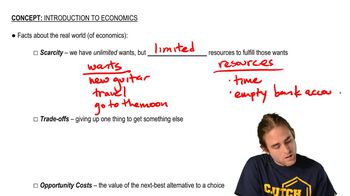
    Scarcity is the condition of limited resources and unlimited wants.
  • Which of the following best describes scarcity?

    Scarcity is the gap between limited resources and unlimited wants.
  • Why would a nation choose not to produce everything its citizens want?

    Because resources are limited and choices must be made.
  • One of the three economic questions deals with deciding what?

    What to produce.
  • A resource has value, and people are willing to pay for it most likely because the resource is what?

    Scarce.
  • A limited amount of goods available means that excess is occurring. True or false?

    False; it means scarcity is occurring.
  • Assessing opportunity cost involves what?

    Comparing the value of alternatives given up.
  • The aspects of a specific location that make people want to move away are called what?

    Push factors (in economics, these relate to opportunity cost of staying).
  • When studying finance or economics, the cost of a decision is also known as a(n) what?

    Opportunity cost.
  • A basic concept in economics is that all resources are scarce, allocated, valuable, or renewable?

    Scarce.
  • A basic concept in economics is that all resources are what?

    Scarce.
  • Gomer decides to spend an hour playing basketball rather than studying. His opportunity cost is what?

    The value of the studying he gave up.
  • Opportunity cost occurs because of a producer’s need to do what?

    Make choices among limited resources.
  • Opportunity cost means that something needs to be replenished, given up, ignored, or paid for?

    Given up.
  • When you must give something up in order to get something else, it is called what?

    A trade-off.
  • Because cost of living varies, it is important to consider what when conducting a job search?

    Opportunity cost and trade-offs.
  • Most resources are nonrenewable, and wants and needs are unlimited. This is an example of what?

    Scarcity.
  • For every decision you make, there is a trade-off. True or false?

    True.
  • ______ economic resources means limited goods and services.

    Scarce.
  • Your opportunity cost of going to a movie is what?

    The value of the next best alternative you gave up, such as studying or working.
  • In a market system, the allocation of scarce goods involves the consideration of what?

    Opportunity costs and trade-offs.