Skip to main content
Microeconomics
My Course
Learn
Exam Prep
AI Tutor
Study Guides
Flashcards
Explore
Try the app
My Course
Learn
Exam Prep
AI Tutor
Study Guides
Flashcards
Explore
Try the app
Back
Short Run Phillips Curve definitions
You can tap to flip the card.
Phillips Curve
You can tap to flip the card.
👆
Phillips Curve
A graphical representation showing the inverse relationship between inflation rate and unemployment rate in the short run.
Track progress
Control buttons has been changed to "navigation" mode.
1/15
Related flashcards
Recommended videos
Short Run Phillips Curve quiz
Short Run Phillips Curve
15 Terms
Guided course
09:33
Short Run Phillips Curve
3
views
Terms in this set (15)
Hide definitions
Phillips Curve
A graphical representation showing the inverse relationship between inflation rate and unemployment rate in the short run.
Inflation
A rise in overall price levels, often measured as a percentage change from one year to the next.
Unemployment
A condition where individuals able and willing to work are unable to find jobs, often expressed as a percentage of the labor force.
Inverse Relationship
A situation where one variable increases as another decreases, such as inflation and unemployment on the Phillips curve.
Aggregate Demand
The total demand for goods and services in an economy at a given overall price level and time period.
Aggregate Supply
The total supply of goods and services that firms in an economy plan to sell during a specific time period.
Equilibrium
A point where aggregate demand equals aggregate supply, determining the economy's price level and output.
GDP
The total value of all goods and services produced within a country, used to gauge economic activity and employment.
Price Level
An index reflecting the average prices of goods and services in an economy, used to measure inflation.
Short Run
A period in which some economic variables are fixed, allowing for temporary trade-offs between inflation and unemployment.
Economic Profits
The surplus earned by firms after accounting for all costs, often influenced by changes in aggregate demand and supply.
Market Equilibrium
A state where supply and demand balance, resulting in stable prices and output levels.
Labor Demand
The need for workers by firms, which rises with increased production and GDP.
Inflation Rate
The percentage change in price level over a specific period, commonly used as the y-axis on the Phillips curve.
Unemployment Rate
The percentage of the labor force without jobs, commonly used as the x-axis on the Phillips curve.
 BackBack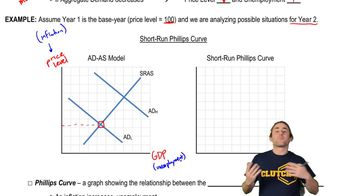
 09:33
09:33