A regressive tax is one where the tax rate decreases as income increases, meaning higher earners pay a lower percentage of their income in taxes compared to lower earners.
Why is the Social Security tax (also known as the payroll tax) considered regressive?
The Social Security tax is considered regressive because it applies a fixed rate up to a certain income limit, so higher earners pay a smaller percentage of their total income in Social Security taxes than lower earners.
What is the difference in tax burdens between individuals with low and high incomes under a regressive tax system?
Under a regressive tax system, individuals with lower incomes pay a higher percentage of their income in taxes than those with higher incomes, resulting in a heavier tax burden for low-income earners.
Who would pay more in sales taxes when making purchases: a low-income individual or a high-income individual?
A low-income individual would pay a higher percentage of their income in sales taxes compared to a high-income individual, making the tax burden heavier for those with lower incomes.
What does tax progressivity mean?
Tax progressivity refers to a tax system where the tax rate increases as income increases, so higher earners pay a larger percentage of their income in taxes.
Overall, the tax system in Texas is generally considered to be regressive. What does this mean?
This means that lower-income individuals in Texas pay a higher percentage of their income in taxes compared to higher-income individuals.
This chart describes a tax system. The individual who benefits most from this policy is probably the one with the highest income. Why?
In a regressive tax system, individuals with higher incomes benefit most because they pay a lower percentage of their income in taxes compared to those with lower incomes.
What type of tax uses a proportional tax rate structure?
A flat income tax uses a proportional tax rate structure, where everyone pays the same percentage of their income regardless of how much they earn.
What is the main idea behind the benefits principle in tax equity?
The benefits principle states that those who receive the benefits from government services should be the ones who pay the taxes that fund those services.
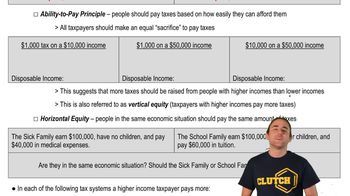
How does horizontal equity complicate the design of a fair tax system?
Horizontal equity is challenging because people with similar incomes may have very different personal expenses, making it difficult to determine if they are truly in the same economic situation for tax purposes.
 Back
Back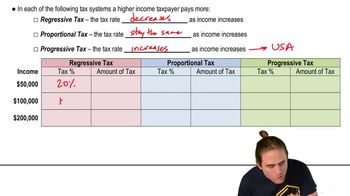
 04:18
04:18