Microeconomics
My Course
Learn
Exam Prep
AI Tutor
Study Guides
Flashcards
Explore
My Course
Learn
Exam Prep
AI Tutor
Study Guides
Flashcards
Explore
Back
The Demand Curve quiz #3
You can tap to flip the card.
The total amount of a product available in a market at a given price is called the
You can tap to
flip the card.
👆
The total amount of a product available in a market at a given price is called the
This is called supply.
Track progress
Control buttons has been changed to "navigation" mode.
1/40
Terms in this set (40)
Hide definitions
The total amount of a product available in a market at a given price is called the
This is called supply.
The demand curve for a typical good has a(n):
The demand curve for a typical good has a negative (downward) slope.
The amount of goods and services consumers want is called the count. demand. number. supply.
The amount consumers want is called demand.
The concept of demand is best described as
Demand is the relationship between price and quantity consumers are willing and able to buy.
The vertical axis of a demand curve shows
The vertical axis shows price.
In economics, the concept of demand is defined as the desire to own something
Demand is defined as the willingness and ability to buy a good at various prices.
A demand curve reflects each of the following except the
A demand curve does not reflect supply.
The demand schedule represents the relationship between the prices of a good, service, or resource:
The demand schedule shows the quantity demanded at each price.
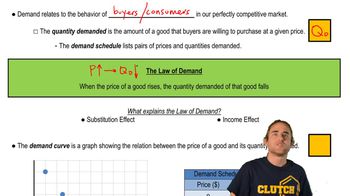
The amount of a good that buyers are willing and able to purchase at a given price
This is called quantity demanded.
The law of demand is the assertion that
The law of demand asserts that as price rises, quantity demanded falls.
Demand is best described as
Demand is the entire relationship between price and quantity demanded.
When quantity demanded decreases in response to a change in price:
This is movement along the demand curve, consistent with the law of demand.
The demand curve for a normal good is downward sloping because
It is downward sloping due to the substitution and income effects.
A decrease in demand is shown by
A decrease in demand is shown by a leftward shift of the demand curve.
A nonprice determinant of demand is:
Consumer income is a nonprice determinant of demand.
A demand curve shows the ______.
A demand curve shows the relationship between price and quantity demanded.
What are the two variables needed to calculate demand?
Price and quantity demanded are needed to calculate demand.
Market demand is based on the:
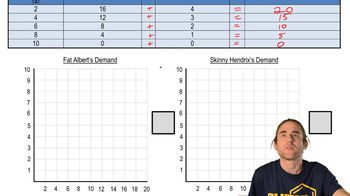
Market demand is based on the sum of all individual demands at each price.
The nature of demand indicates that as the price of a good increases:
As price increases, quantity demanded decreases.
When we move along a given demand curve,
We are changing the price, which changes quantity demanded.
A factor that most directly affects the demand for automobiles is
Consumer income most directly affects demand for automobiles.
The demand curve for money shifts to the right when
The demand curve for money shifts right when people want to hold more money, such as during economic growth.
A demand curve enables a firm to examine prices
A demand curve helps a firm predict how changes in price affect quantity sold.
This chart is an example of a demand curve, demand schedule, supply curve, supply schedule.
If the chart shows price and quantity demanded, it is a demand schedule.
A decrease in demand while holding supply constant results in
A decrease in demand leads to a lower equilibrium price and quantity.
When looking at a graph of aggregate demand, which of the following is correct?
Aggregate demand is downward sloping, showing an inverse relationship between price level and quantity demanded.
Which of the following accurately characterize demand curves? (choose every correct answer.)
Demand curves are downward sloping and show the relationship between price and quantity demanded.
Assuming ceteris paribus, what principle behind the law of demand is this graph illustrating?
The graph illustrates that as price falls, quantity demanded rises, holding other factors constant.
What is the difference between change in quantity demanded and change in demand?
Change in quantity demanded is movement along the curve due to price; change in demand is a shift of the curve due to other factors.
Which statement accurately describes the relationship between price and quantity demanded?
Price and quantity demanded are inversely related.
The law of demand states that, other things equal, when the price of a good
When the price of a good rises, quantity demanded falls.
The following graph displays four demand curves (ll, mm, nn, and oo) that intersect at point a.
The intersection at point a shows the same quantity demanded at a specific price for all four curves.
The demand curve of a monopolistically competitive producer is
The demand curve is downward sloping, reflecting some market power.
The graph shows the demand curve faced by a pure monopolist
A pure monopolist faces a downward-sloping demand curve.
A publisher faces the following demand schedule for the next novel from one of its popular authors:
The demand schedule shows the quantity demanded at each price for the novel.
If the demand for a product increases, then we would expect equilibrium price
Equilibrium price will rise if demand increases, holding supply constant.
The accompanying graph illustrates a market for cigarettes
The graph likely shows the relationship between price and quantity demanded for cigarettes.
The graph depicts five demand curves
The five demand curves show different relationships between price and quantity demanded, possibly reflecting shifts in demand.
The table shows the demand curve for monster trucks
The table lists quantity demanded at various prices for monster trucks.
A decrease in consumer preference for a product, other things being equal, will cause:
A decrease in preference will shift the demand curve to the left.