What does the consumption function illustrate in economics?
The consumption function shows how household consumption changes with disposable income, which is income after taxes.
What is disposable income?
Disposable income is the money households have left after paying taxes, which can be used for consumption or saving.
What are the two main uses of disposable income?
Disposable income can be used for consumption or saving.
What is the 45 degree line in the context of the consumption function graph?
The 45 degree line represents the scenario where every dollar of disposable income is spent on consumption.
What does autonomous consumption mean in the consumption function?
Autonomous consumption is the amount households consume even when disposable income is zero.
What happens when the consumption function is below the 45 degree line?
When the consumption function is below the 45 degree line, some disposable income is being saved.
What is dis-saving in the context of the consumption function?
Dis-saving occurs when households consume more than their disposable income, often by using savings or taking on debt.
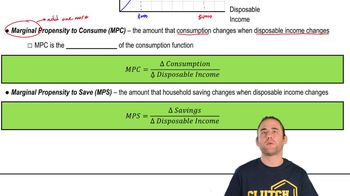
What is the marginal propensity to consume (MPC)?
MPC measures how much consumption increases for each additional dollar of disposable income.
How is the marginal propensity to consume (MPC) calculated?
MPC is calculated as the change in consumption divided by the change in disposable income.
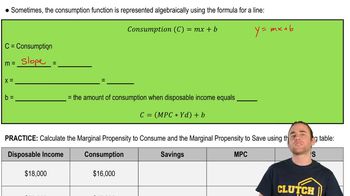
What does the slope of the consumption function represent?
The slope of the consumption function represents the marginal propensity to consume (MPC).
What is the marginal propensity to save (MPS)?
MPS measures how much savings increase for each additional dollar of disposable income.
What is the relationship between MPC and MPS?
MPC plus MPS always equals 1, since all disposable income is either consumed or saved.
What is the equation for the consumption function?
The consumption function is C = MPC × YD + b, where C is consumption, YD is disposable income, MPC is the marginal propensity to consume, and b is autonomous consumption.
What does 'b' represent in the consumption function equation?
'b' represents autonomous consumption, or the amount consumed when disposable income is zero.
How can you use the consumption function equation to find consumption at a given disposable income?
Plug the value of disposable income into the equation C = MPC × YD + b to calculate the corresponding consumption.
 Back
Back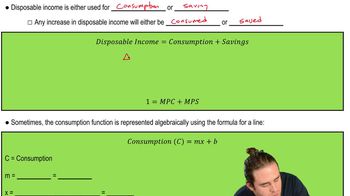
 02:45
02:45