Skip to main content
Microeconomics
My Course
Learn
Exam Prep
AI Tutor
Study Guides
Flashcards
Explore
Try the app
My Course
Learn
Exam Prep
AI Tutor
Study Guides
Flashcards
Explore
Try the app
Back
The Demand for Money definitions
You can tap to flip the card.
Money Demand
You can tap to flip the card.
👆
Money Demand
Desire to keep cash on hand instead of investing, influenced by interest rates and other economic factors.
Track progress
Control buttons has been changed to "navigation" mode.
1/15
Related flashcards
Recommended videos
The Demand for Money quiz
The Demand for Money
15 Terms
02:17
Shifting Money Demand
6
views
01:51
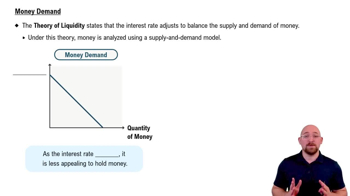
Money Demand
3
views
Terms in this set (15)
Hide definitions
Money Demand
Desire to keep cash on hand instead of investing, influenced by interest rates and other economic factors.
Liquidity
Ability to quickly access cash or assets without significant loss in value, central to holding money decisions.
Interest Rate
Cost of borrowing funds, acting as the price for holding money versus investing in assets.
Opportunity Cost
Value of the best alternative forgone, such as potential returns missed by holding cash instead of investing.
Supply and Demand Model
Graphical representation used to analyze how money demand and interest rates interact in the market.
Trade Off
Economic choice between holding cash and investing, requiring a decision due to limited resources.
Price Level
Average of current prices for goods and services, affecting how much money people need to hold.
Inflation
General increase in prices, prompting greater demand for cash to cover higher everyday expenses.
Money Demand Curve
Graph showing the relationship between interest rates and the quantity of money people wish to hold.
Quantity of Money
Amount of cash individuals choose to keep rather than invest, determined by economic conditions.
Ceteris Paribus
Assumption that all other factors remain constant when analyzing the effect of interest rates on money demand.
Market Equilibrium
Point where money supply and money demand balance, setting the prevailing interest rate.
Asset
Resource with economic value, such as cash or investments, considered when deciding to hold or invest money.
Shift
Movement of the money demand curve caused by factors other than interest rates, like technology or price changes.
Determinant
Factor influencing money demand, including interest rates, price levels, and technological advancements.
 BackBack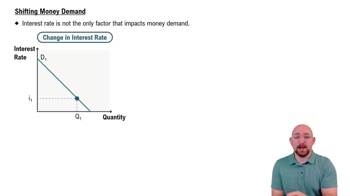
 02:17
02:17