The gold standard was a system where a country's currency value was directly linked to the amount of gold it held in reserves.
How were exchange rates determined under the gold standard?
Exchange rates were determined by the amount of gold backing each currency, so the value of one currency relative to another depended on their respective gold reserves.
What could you do with paper money under the gold standard that you cannot do today?
You could exchange paper money for actual gold from the government under the gold standard, which is not possible today.
Which country was the first to adopt the gold standard?
The United Kingdom was the first country to adopt the gold standard in 1816.
By what year had most countries in Europe and the Western Hemisphere adopted the gold standard?
By 1913, most countries in Europe and the Western Hemisphere had adopted the gold standard.
If one US dollar was backed by one-third of an ounce of gold and one British pound by one ounce, what was the exchange rate?
The exchange rate would be three US dollars per one British pound.
Why did the gold standard limit a country's monetary policy?
Because the money supply was constrained by the amount of gold in reserves, countries could not freely increase the money supply or conduct flexible monetary policy.
What major economic event led many countries to abandon the gold standard?
The Great Depression in the 1930s led many countries to abandon the gold standard.
How did the gold standard affect countries during the Great Depression?
Countries that stayed on the gold standard longer experienced longer and more severe depressions.
Why has the gold standard not been reinstated since the Great Depression?
Because it restricted monetary policy and prolonged economic downturns, no real attempt has been made to reinstate the gold standard.
What was a major drawback of the gold standard?
A major drawback was the lack of control over the money supply, making it difficult to respond to economic crises.
How did the gold standard ensure the value of currency?
Each unit of currency was backed by a specific amount of gold, ensuring its value was tied to gold reserves.
What happened to the value of currency if a country printed more money without increasing gold reserves?
The currency would lose its value if more money was printed without additional gold to back it up.
What is one thing you can do with gold today that you could not do under the gold standard?
Today, you can buy gold on the market, but you cannot exchange paper money for gold at a bank as you could under the gold standard.
What role did the United Kingdom play in the spread of the gold standard?
As the center of international trade, the United Kingdom's adoption of the gold standard encouraged other countries to follow.
 Back
Back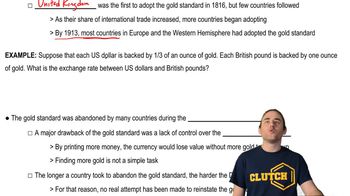
 04:53
04:53