What does the Laffer Curve suggest about the relationship between tax rates and tax revenue?
The most plausible statement is that increasing tax rates beyond a certain point can decrease tax revenue, because higher taxes reduce the quantity exchanged, leading to less overall revenue for the government.
What scenario is consistent with the Laffer Curve regarding tax rates and tax revenue?
A scenario where raising the tax rate from a medium to a high level causes tax revenue to decrease, because the higher tax discourages transactions and reduces the quantity exchanged, is consistent with the Laffer Curve.
How does increasing the size of a tax affect the quantity exchanged in a market?
As the size of a tax increases, the quantity exchanged in the market decreases because higher taxes raise costs for buyers and lower returns for sellers.
What does the area of the box between the demand and supply curves represent when a tax is imposed?
The area of the box represents the total tax revenue collected by the government, calculated as the tax per unit times the quantity exchanged.
Why does a very large tax not necessarily result in much higher tax revenue compared to a small tax?
A very large tax greatly reduces the quantity exchanged, so even though the tax per unit is high, the overall tax revenue does not increase much because fewer transactions occur.
On the Laffer Curve graph, what is shown on the x-axis and y-axis?
The x-axis shows the size of the tax, while the y-axis shows the amount of tax revenue received by the government.
What shape does the Laffer Curve typically have, and what does this shape indicate?
The Laffer Curve has a parabolic shape, indicating that tax revenue increases with tax rate up to a maximum point, then decreases as tax rates continue to rise.
Who created the concept of the Laffer Curve and what did he suggest about the USA's position on it?
Arthur Laffer created the Laffer Curve and suggested that the USA was on the downward slope, meaning further tax increases would reduce tax revenue.
What happens to the price buyers pay and the price sellers receive when a tax is imposed?
When a tax is imposed, buyers pay a higher price and sellers receive a lower price, with the difference going to the government as tax revenue.
Why can't we specify the exact tax rate that maximizes tax revenue for every market?
The optimal tax rate varies by market due to differences in demand and supply conditions, so it is not possible to determine a universal maximizing tax rate.
 Back
Back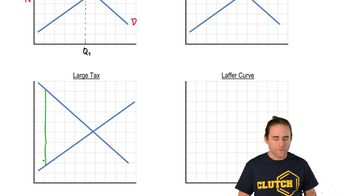
 09:01
09:01