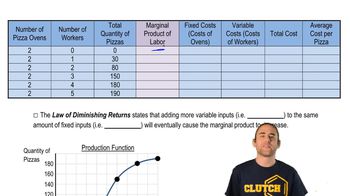
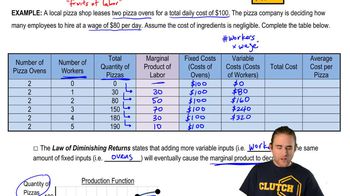
What is the law of diminishing returns, and how does it affect production as more workers are added?
The law of diminishing returns states that as more variable inputs (like workers) are added to a fixed input (such as ovens), the marginal product of each additional worker eventually decreases. This means each new worker adds less to total output than the previous one, due to limited fixed resources.
At what point (number of workers) does diminishing marginal product begin in the pizza shop example?
Diminishing marginal product begins after the third worker is hired. The marginal product increases up to the third worker, but adding the fourth worker results in a smaller increase in output, indicating diminishing returns.
Given the production function q = 12lk, what do the variables l and k represent?
In the production function q = 12lk, 'l' represents the quantity of labor (workers) and 'k' represents the quantity of capital (such as ovens). The function shows how output depends on the amount of labor and capital used.
Why does the production function represent short-run production?
The production function represents short-run production because at least one input (capital, like ovens) is fixed, while other inputs (labor) can be varied. In the short run, firms cannot adjust all inputs freely.
Which of the following would be a likely mathematical expression for total variable cost in the pizza shop example?
A likely mathematical expression for total variable cost is: Variable Cost = Wage × Number of Workers (VC = w × L), where w is the wage per worker and L is the number of workers hired.
How is the marginal product of labor (MPL) calculated in the pizza shop example?
MPL is calculated by subtracting the previous total output from the new total output after adding one more worker. For example, if output increases from 80 to 150 pizzas when a third worker is hired, the MPL is 70 pizzas.
Why does the marginal product of labor initially increase when more workers are added?
The marginal product of labor initially increases because workers can specialize and divide tasks, making production more efficient. This leads to greater output per worker before diminishing returns set in.
What happens to the slope of the production function graph as more workers are added?
The slope of the production function graph becomes less steep as more workers are added, indicating that each additional worker contributes less to total output. This visual change reflects the law of diminishing returns.
How do fixed costs behave as output increases in the pizza shop example?
Fixed costs remain constant at $100 regardless of the number of pizzas produced or workers hired. They do not change with output because they are associated with the ovens, which are a fixed input.
What is the relationship between average cost per pizza and the marginal product of labor?
Average cost per pizza decreases when the marginal product of labor is rising, and increases when the marginal product of labor starts to fall. This is because higher MPL means more output per worker, lowering the cost per unit.