The Production Function and Marginal Revenue Product quiz #1 Flashcards
The Production Function and Marginal Revenue Product quiz #1
You can tap to flip the card.
Control buttons has been changed to "navigation" mode.
1/10
Terms in this set (10)
What does the production and transfer of wealth in societies refer to in the context of microeconomics?
The production and transfer of wealth in societies refers to how factors of production—land, labor, physical capital, human capital, and entrepreneurship—are used and exchanged in markets to create goods and services, generating income and wealth for individuals and firms.
The marginal revenue product of labor is the additional revenue a firm earns from hiring one more unit of labor. How is it calculated?
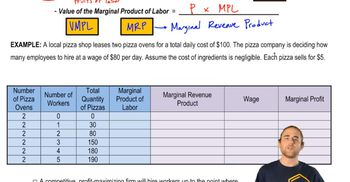
The marginal revenue product of labor is calculated by multiplying the marginal product of labor (the extra output from one more worker) by the price at which the output is sold: MRP = MPL × Price.
Who demands the factors of production in the factors of production markets?
Firms demand the factors of production in these markets so they can produce goods and services.
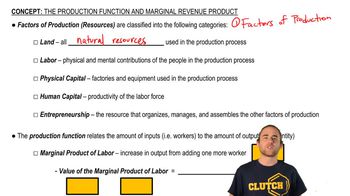
What is included in the 'land' category of factors of production?
Land includes all natural resources such as land itself, forests, and underground oil deposits.
How does education and training affect human capital?
Education and training increase human capital by making workers more productive.
What role does entrepreneurship play among the factors of production?
Entrepreneurship organizes, manages, and assembles the other factors of production, bringing ideas and innovation.
What does the production function relate in the context of labor?
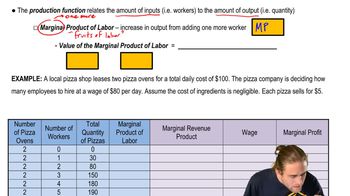
The production function relates the amount of inputs, such as workers, to the amount of outputs produced.
What does the marginal product of labor (MPL) measure?
The marginal product of labor measures the additional output produced by hiring one more worker.
How do you determine the extra revenue a firm earns from hiring an additional worker?
You multiply the marginal product of labor by the price at which the output is sold to get the marginal revenue product.
Why is the term 'marginal revenue product' preferred over 'value of marginal product of labor'?
The term 'marginal revenue product' is preferred because it clearly refers to the extra revenue generated, making its meaning more obvious.