Skip to main content
Microeconomics
My Course
Learn
Exam Prep
AI Tutor
Study Guides
Flashcards
Explore
Try the app
My Course
Learn
Exam Prep
AI Tutor
Study Guides
Flashcards
Explore
Try the app
Back
Value Added Method for Measuring GDP quiz
You can tap to flip the card.
What does the value added approach to GDP calculation sum up?
You can tap to flip the card.
👆
What does the value added approach to GDP calculation sum up?
It sums the value added by firms producing final goods and services.
Track progress
Control buttons has been changed to "navigation" mode.
1/15
Related flashcards
Recommended videos
Value Added Method for Measuring GDP definitions
Value Added Method for Measuring GDP
14 Terms
02:21
Value Added Method for Measuring GDP
8
views
Terms in this set (15)
Hide definitions
What does the value added approach to GDP calculation sum up?
It sums the value added by firms producing final goods and services.
How do you calculate value added for a firm?
Value added is calculated as the sale price of the good minus the cost of intermediate goods used to produce it.
In the value added method, what are intermediate goods?
Intermediate goods are goods that are used as inputs in the production of final goods.
If a farm sells wheat for \$2 with no intermediate costs, what is its value added?
The value added is \$2, since \$2 (sale price) minus \$0 (intermediate costs) equals \$2.
How much value does a flour mill add if it buys wheat for \$2 and sells flour for \$5?
The flour mill adds \$3 in value, calculated as \$5 (sale price) minus \$2 (cost of wheat).
What is the value added by a bakery that buys flour for \$5 and sells bread for \$7.50?
The bakery adds \$2.50 in value, calculated as \$7.50 (sale price) minus \$5 (cost of flour).
What is the total value added in the example of farm, flour mill, and bakery?
The total value added is \$7.50, which is the sum of \$2 (farm), \$3 (flour mill), and \$2.50 (bakery).
How does the value of the final good relate to the total value added in the value added approach?
The value of the final good (bread) is equal to the total value added by all firms in the production chain.
Does the value added approach yield the same GDP as the expenditure and income approaches?
Yes, all three approaches yield the same GDP value.
Why might different countries use different methods for calculating GDP?
The choice depends on the economy or economist's preference, but all methods give the same result.
What is the least common method for calculating GDP?
The value added approach is the least common method.
Why is it important to subtract the cost of intermediate goods when calculating value added?
Subtracting intermediate costs prevents double counting the value of goods used in production.
What does the value added approach help us see in the production process?
It helps us see how much value each firm adds at each stage of production.
If the bakery's bread sells for \$7.50, what does this amount represent in the value added method?
It represents the total value added by all firms in the production chain.
What is a key takeaway about GDP calculation methods from this lesson?
All three methods—expenditure, income, and value added—will give the same GDP calculation.
 BackBack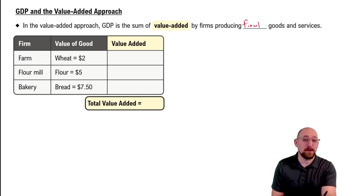
 02:21
02:21