 Back
MGMT 1035 Global business MIDTERM
You can tap to flip the card.
Control buttons has been changed to "navigation" mode.
1/25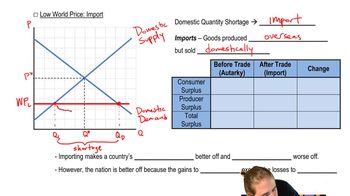
 06:36

Terms in this set (25)
Economic: Economic decisions impacting multiple countries.
Cultural: Spread of cultural practices worldwide.
Telegram: Early global communication via Morse code.
Telephone: Allowed global voice communication.
Internet: Connected people and information worldwide.
2. Consumers pay more, reducing resource access.
3. Slows economic growth by reducing trade willingness.
Powerful countries: Use political and economic influence globally.
Small countries: Vulnerable to economic shocks and cultural changes.
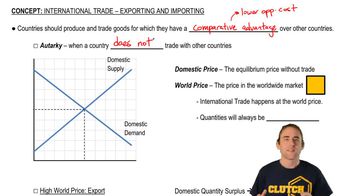
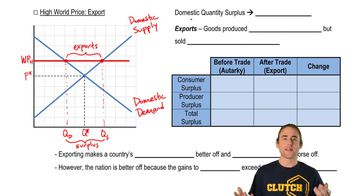
Absolute advantage: Producing more volume of goods while using fewer inputs. Comparative advantage: Producing at lower opportunity cost, enabling beneficial trade even if one is better at both.
The idea that a country exports goods that intensively use its abundant and cheap baseline resources (like land, labor, or high-skill human capital) and imports goods that use resources it lacks.
Analogy: You bake what you have the ingredients for.
Government support (subsidies, tax breaks) helps domestic firms compete globally. (Especially when only a few large firms dominate.)
2. Geopolitical risks, e.g., dependence on Taiwan for chips.
Bilateral: Between two countries (Canada-US free trade).
Multilateral: Many countries (NAFTA, WTO).
Pros: Stability and predictability. Cons: Difficult to change and requires constant government intervention.
Cons: Volatility and speculation risks.
World Bank: Infrastructure and development loans.
GATT/WTO: Trade rules and dispute resolution.
How are regional trade agreements (RTAs) obstacles/stepping stones?
Stepping stones: Promote faster market opening than stalled global talks.