 Back
Microeconomics: Consumer Choice and Behavioral Economics
 09:38

Terms in this set (21)
Utility is the enjoyment or satisfaction people receive from consuming goods and services, measured in utils.
Marginal Utility is the change in total utility a person receives from consuming one additional unit of a good or service.
The principle that consumers experience decreasing additional satisfaction as they consume more of a good or service during a given period.
A budget constraint is the limited amount of income available to consumers to spend on goods and services.
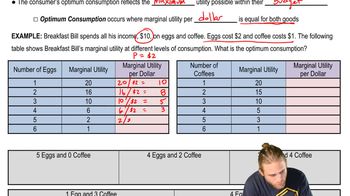
To maximize utility, consumers buy goods up to the point where the last unit of each good purchased provides equal marginal utility per dollar spent.
Marginal Utility per Dollar = \(\frac{MU}{P}\), where MU is marginal utility and P is price.
1) Marginal utility per dollar spent must be equal across goods.
2) Total spending must equal the budget constraint.
If the price of a good decreases, quantity demanded usually increases for a normal good and decreases for an inferior good.
The market demand curve is the horizontal sum of all individual demand curves for a good.
Consumers' decisions are influenced by peers, culture, customs, religion, and celebrity endorsements, affecting perceived utility.
A situation where the usefulness of a product increases as more people use it, e.g., cell phones or apps for tablets.
Consumers care about fairness and may act to treat others fairly, even at a personal financial cost.
Sunk costs are costs that have already been paid and cannot be recovered; they should be ignored in decision-making.
The tendency to value a good more highly simply because one owns it, leading to unwillingness to sell at market price.
The study of situations where people make choices that do not appear economically rational.
1) Ignoring non-monetary opportunity costs.
2) Failing to ignore sunk costs.
3) Being unrealistic about future behavior.
Costs of using owned goods that could be sold or used otherwise, often overlooked in decision-making.
Inferior goods with upward-sloping demand curves where demand increases as price rises, due to strong income effects.
Curves showing combinations of goods that provide the same utility to a consumer.
The rate at which a consumer is willing to trade one good for another while maintaining the same utility level.
The point where the budget constraint is tangent to the highest possible indifference curve, indicating maximum utility.