Skip to main content
Microeconomics
My Course
Learn
Exam Prep
AI Tutor
Study Guides
Flashcards
Explore
Try the app
My Course
Learn
Exam Prep
AI Tutor
Study Guides
Flashcards
Explore
Try the app
Back
Microeconomics Core Concepts: Consumer and Producer Behavior, Market Equilibrium, and Efficiency
You can tap to flip the card.
Buyer’s Problem
You can tap to flip the card.
👆
Buyer’s Problem
Consumers choose combinations of goods and services to maximize satisfaction given limited income and prices.
Track progress
Control buttons has been changed to "navigation" mode.
1/31
Recommended videos
Guided course
08:41
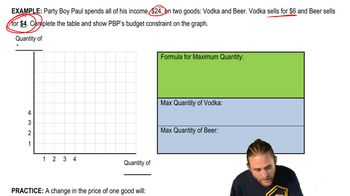
Budget Constraint (Budget Line)
3735
views
60
rank
Guided course
03:50
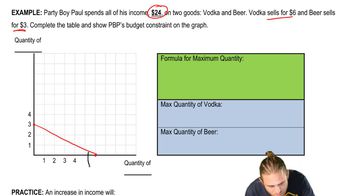
Budget Constraint:Change in Price of a Good
2147
views
22
rank
Guided course
03:44
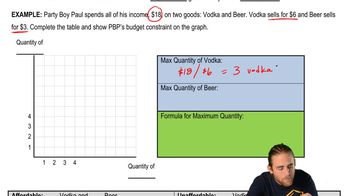
Budget Constraint:Change in Income
2101
views
28
rank
Terms in this set (31)
Hide definitions
Buyer’s Problem
Consumers choose combinations of goods and services to maximize satisfaction given limited income and prices.
Budget Set
All possible bundles of goods and services a consumer can afford with a given income and prices.
Budget Constraint
Equation representing all combinations of goods that exactly exhaust the consumer’s income.
Opportunity Cost
The value of the next best alternative forgone when making a choice.
Decisions at the Margin
Consumers compare the additional benefit of one more unit to its additional cost before deciding.
Example of Budget Constraint
If books cost \$20 and movies \$10 with \$100 income, budget constraint is \(20B + 10M = 100\).
Consumer Surplus
Difference between what consumers are willing to pay and what they actually pay.
Price Elasticity of Demand
Measures responsiveness of quantity demanded to a change in price.
Price Elasticity of Demand Formula
\(\varepsilon = \frac{\%\ \text{change in quantity demanded}}{\%\ \text{change in price}}\)
Arc Elasticity
Calculates elasticity over a range of prices and quantities.
Arc Elasticity Formula
\(\varepsilon = \frac{(Q_2 - Q_1)/[(Q_2 + Q_1)/2]}{(P_2 - P_1)/[(P_2 + P_1)/2]}\)
Cross-Price Elasticity
Measures how quantity demanded of one good responds to a price change in another good.
Cross-Price Elasticity Formula
\(\varepsilon_{xy} = \frac{\%\ \text{change in } Q_x}{\%\ \text{change in } P_y}\)
Income Elasticity of Demand
Measures how quantity demanded responds to a change in consumer income.
Income Elasticity Formula
\(\varepsilon_I = \frac{\%\ \text{change in quantity demanded}}{\%\ \text{change in income}}\)
Types of Price Elasticity
Elastic: |ε| > 1, Inelastic: |ε| < 1, Unit Elastic: |ε| = 1, Perfectly Elastic: |ε| = ∞, Perfectly Inelastic: |ε| = 0.
Substitutes vs Complements
Substitutes have positive cross-price elasticity; complements have negative cross-price elasticity.
Normal vs Inferior Goods
Normal goods have positive income elasticity; inferior goods have negative income elasticity.
Perfect Competition Characteristics
Many buyers and sellers, homogeneous products, free entry and exit, perfect information.
Short Run vs Long Run in Production
Short run: at least one input fixed; Long run: all inputs variable.
Marginal Product
Additional output from using one more unit of input.
Law of Diminishing Returns
Adding more of a variable input to a fixed input eventually yields lower additional output.
Total Cost (TC)
Sum of all costs incurred in production.
Average Total Cost (ATC) Formula
\(ATC = \frac{TC}{Q}\)
Marginal Cost (MC) Formula
\(MC = \frac{\Delta TC}{\Delta Q}\)
Profit Formula
\(\text{Profit} = \text{Total Revenue} - \text{Total Cost}\)
Shutdown Rule (Short Run)
Firm should shut down if price is less than average variable cost.
Producer Surplus
Difference between the price received and the minimum price a producer is willing to accept.
Economies of Scale
Long-run average total cost decreases as output increases.
Deadweight Loss
Loss of total surplus due to market distortions like taxes or price controls.
Pareto Efficiency
No one can be made better off without making someone else worse off.
 BackBack
 08:41