 Back
BackMicroeconomics: Cost, Production, and Market Supply
 04:27
04:27
Terms in this set (28)
User cost of capital is the opportunity cost of using capital, including depreciation and the return that could be earned elsewhere.
Rental cost of capital is the actual payment made to use capital for a period, reflecting its opportunity cost.
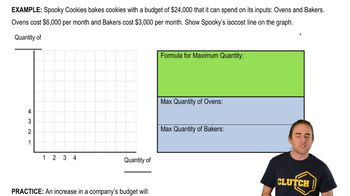
An isocost line shows all combinations of inputs that cost the same total amount to the firm.
To produce a given output at minimum cost, the firm sets \(\frac{MPL}{MPK} = \frac{w}{r}\), equating the marginal product ratio to the input price ratio.
The expansion path traces the cost-minimizing input combinations as output changes in the long run.
Long-run costs are derived from the firm’s expansion path by finding the minimum cost input combinations for each output level.
The long-run average cost curve is the envelope of all short-run average cost curves, showing minimum cost at each output when all inputs are variable.
The long-run marginal cost curve intersects the long-run average cost curve at its minimum point.
Economies of scale occur when increasing output lowers average cost.
Diseconomies of scale occur when increasing output raises average cost.
Increasing returns to scale means output increases more than inputs; economies of scale means average cost decreases as output increases.
Cost output elasticity measures the percentage change in cost resulting from a 1% change in output.
Economies of scope occur when producing multiple outputs together costs less than producing them separately.
The degree of economies of scope quantifies cost savings from joint production relative to separate production.
Diseconomies of scope occur when joint production costs more than separate production.
Many buyers and sellers, identical products, free entry and exit, and perfect information define a perfectly competitive market.
A perfectly competitive firm chooses output where price equals marginal cost to maximize profit.
For a competitive firm, marginal revenue equals price because the firm is a price taker.
A firm shuts down in the short run if price is below average variable cost, minimizing losses.
The short-run supply curve is the portion of the marginal cost curve above average variable cost.
Long-run supply can be constant cost, increasing cost, or decreasing cost depending on input price changes as industry output changes.
Consumer surplus is the difference between willingness to pay and price; producer surplus is the difference between price and cost.
Deadweight loss is the loss of total surplus due to market inefficiencies like taxes or price controls.
Price ceilings and floors cause shortages or surpluses and create deadweight loss, reducing total welfare.
Production quotas limit output, often raising prices but causing inefficiency and deadweight loss.
Import quotas limit quantity imported; tariffs are taxes on imports, both affecting prices and welfare.
Tax incidence depends on the relative elasticities of supply and demand, determining who bears the tax burden.
Taxes raise prices consumers pay and lower prices suppliers receive, causing deadweight loss; subsidies have opposite effects.