 Back
BackMicroeconomics Exam 1 Notes
 01:42
01:42

Terms in this set (26)
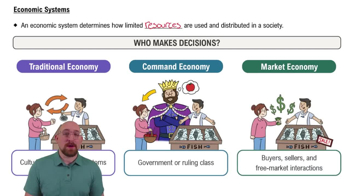
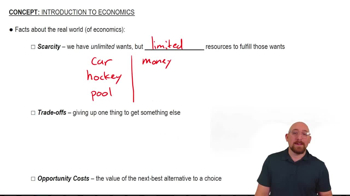
Scarcity is our inability to get everything we want because resources are limited.
Economics is a social science that encourages an action or a quality that discourages one.
Microeconomics studies the behavior of individuals and firms in making decisions and the interactions in markets.
Macroeconomics studies the economy as a whole and deals with aggregate measures like GDP, unemployment, and inflation.
The economic problem is how to allocate scarce resources to satisfy unlimited wants.
Opportunity cost is the value of the next best alternative foregone when making a decision.
The PPF shows the maximum possible output combinations of two goods that can be produced with available resources and technology.
A point inside the PPF represents inefficient use of resources.
A point outside the PPF is unattainable with current resources and technology.
An outward shift of the PPF indicates economic growth due to increased resources or improved technology.
The law of demand states that, ceteris paribus, as price decreases, quantity demanded increases.
The law of supply states that, ceteris paribus, as price increases, quantity supplied increases.
Market equilibrium occurs where quantity demanded equals quantity supplied.
When price is above equilibrium, there is a surplus, causing price to fall.
When price is below equilibrium, there is a shortage, causing price to rise.
Price elasticity of demand measures how much quantity demanded responds to a change in price.
Price elasticity of demand = \(\frac{\%\text{ change in quantity demanded}}{\%\text{ change in price}}\)
Demand is elastic if quantity demanded changes more than price (elasticity > 1).
Demand is inelastic if quantity demanded changes less than price (elasticity < 1).
Consumer surplus is the difference between what consumers are willing to pay and what they actually pay.
Producer surplus is the difference between the price producers receive and their minimum acceptable price.
A price ceiling set below equilibrium causes shortages.
A price floor set above equilibrium causes surpluses.
A change in demand shifts the demand curve; a change in quantity demanded moves along the demand curve due to price change.
Factors include income, prices of related goods, tastes, expectations, and number of buyers.
Factors include input prices, technology, expectations, number of sellers, and taxes or subsidies.