 Back
BackMicroeconomics Final Exam Key Concepts
 06:02
06:02
Terms in this set (25)
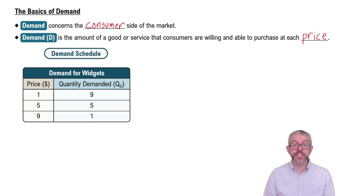
Law of demand states that, ceteris paribus, as price decreases, quantity demanded increases, and vice versa.
Market equilibrium occurs where \(Q_d = Q_s\), meaning quantity demanded equals quantity supplied.
A shortage occurs when price is below equilibrium, causing \(Q_d - Q_s\) to be positive.
A surplus occurs when price is above equilibrium, causing \(Q_s - Q_d\) to be positive.
Law of supply states that, ceteris paribus, as price increases, quantity supplied increases, and vice versa.
Producer surplus is the area between the price and the marginal cost curve for the firm’s quantity supplied.
Total Cost is the sum of variable cost and fixed cost: \(TC = VC + FC\).
Average total cost is total cost divided by quantity: \(ATC = \frac{TC}{Q}\), or sum of average variable and average fixed costs.
Total revenue is price times quantity sold: \(TR = P \times Q\).
Marginal revenue is the change in total revenue from selling one more unit: \(MR = \frac{\Delta TR}{\Delta Q}\).
Profit is maximized where marginal cost equals marginal revenue: \(MC = MR\).
Profit is total revenue minus total cost: \(\pi = TR - TC\) or \(\pi = (P - ATC) \times Q\).
A monopoly is a market structure with a single seller who controls the entire supply of a product with no close substitutes.
Price discrimination types: 1st degree (perfect), 2nd degree (by quantity blocks), and 3rd degree (by consumer groups).
Marginal social cost equals marginal cost plus marginal external cost: \(MSC = MC + MEC\).
Marginal social benefit equals marginal benefit plus marginal external benefit: \(MSB = MB + MEB\).
Rivalry means one person's use reduces availability for others; excludability means people can be prevented from using the good.
Goods are classified as public, common, club, or private based on rivalry and excludability.
Comparative advantage means producing a good at a lower opportunity cost than others.
Opportunity cost of good A: \(OCA = \frac{Quantity\ of\ Good\ B\ Given\ Up}{Quantity\ of\ Good\ A\ Gained}\).
Tariff revenue equals tariff rate times quantity of imports: \(Tariff\ Revenue = Tariff\ Rate \times Quantity\ of\ Imports\).
Consumer surplus is the area below the demand curve and above the market price.
Producer surplus is the area above the supply curve and below the market price.
Area of a triangle (used for surplus and deadweight loss): \(Area = \frac{1}{2} \times Base \times Height\).
Area of a rectangle (used for tariff revenue): \(Area = Base \times Height\).