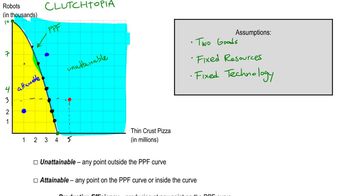
What does the Production Possibilities Frontier (PPF) represent?
The PPF shows the maximum attainable combinations of two goods that can be produced with available resources and current technology.
What is the opportunity cost of producing more of one good on the PPF?
The opportunity cost is the amount of the other good that must be given up to produce more of the first good.
What does a point inside the PPF indicate?
A point inside the PPF is attainable but inefficient because resources are not fully used.
What does an outward shift of the PPF represent?
An outward shift of the PPF represents economic growth, meaning the economy can produce more goods and services.
What is the difference between a change in demand and a change in quantity demanded?
A change in demand shifts the demand curve, while a change in quantity demanded is a movement along the demand curve due to price changes.
What happens to price if there is a surplus in the market?
If there is a surplus (quantity supplied > quantity demanded), the price tends to fall.
What happens to price if there is a shortage in the market?
If there is a shortage (quantity demanded > quantity supplied), the price tends to rise.
What is economic efficiency in a competitive market?
Economic efficiency occurs when marginal benefit equals marginal cost, maximizing the sum of consumer and producer surplus.
What is consumer surplus?
Consumer surplus is the difference between the highest price a consumer is willing to pay and the price actually paid.
What is producer surplus?
Producer surplus is the difference between the price producers receive and the minimum price they are willing to accept.
What is a binding price floor and its effects?
A binding price floor is set above equilibrium, favors producers, creates a surplus, and causes deadweight loss.
What is a binding price ceiling and its effects?
A binding price ceiling is set below equilibrium, favors consumers, creates a shortage, and causes deadweight loss.
How is the incidence of a tax shared between consumers and producers?
The tax incidence depends on the relative elasticities of supply and demand; both consumers and producers share the tax burden.
What is a positive externality?
A positive externality occurs when a decision creates benefits for people not directly involved in the transaction.
What is the Coase Theorem?
The Coase Theorem states that if property rights are clear and transaction costs are low, private bargaining can solve externality problems efficiently.
What is the tragedy of the commons?
The tragedy of the commons occurs when common resources are overused because they are nonexcludable but rival in consumption.
How does the elasticity of demand vary with product definition?
Demand is more elastic for narrowly defined products because consumers have more substitutes.
What happens to total revenue when price rises and demand is elastic?
Total revenue falls when price rises if demand is elastic (elasticity > 1).
What is comparative advantage?
Comparative advantage is the ability to produce a good at a lower opportunity cost than competitors.
What are the effects of tariffs on consumers and producers?
Tariffs make domestic consumers worse off, help domestic producers, and cause deadweight loss to the economy.
What is marginal cost?
Marginal cost is the additional cost of producing one more unit of output.
What is the shape of the average total cost curve and why?
The average total cost curve is U-shaped because average costs fall then rise as output increases.
What is price discrimination and when is it possible?
Price discrimination occurs when firms with market power charge different prices to different consumer groups who cannot resell the product.
 Back
Back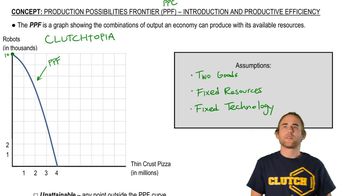
 06:23
06:23