 Back
BackMicroeconomics Final Exam Study Guide (Ch. 12-15)
 06:29
06:29
Terms in this set (31)
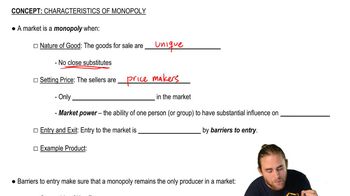
A market structure where one firm is the only seller of a good or service with no close substitutes.
Anything that prevents new firms from entering a market, maintaining monopoly power.
Legal barriers (patents, licenses), control of resources, and economies of scale.
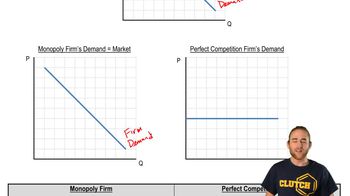
A firm that can set its own price, typical of monopolies.
A firm that must accept the market price, typical in perfect competition.
The extra revenue from selling one more unit; for monopolies, MR is less than price.
A firm maximizes profit where \(MR=MC\) (marginal revenue equals marginal cost).
Lost economic efficiency when output is lower than the socially optimal level, common in monopolies.
Charging different prices to different customers for the same product.
First-degree: charge max each will pay; Second-degree: price varies by quantity; Third-degree: different groups.
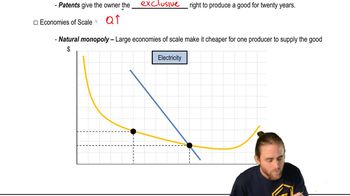
A monopoly where one firm supplies the entire market at lower cost due to high fixed costs.
Includes setting price ceilings and breaking up firms via antitrust laws.
Market with many firms, differentiated products, and free entry/exit.
Making a product seem different (real or perceived) from competitors.
Firms produce below efficient output level in the long run.
Firms break even because new firms enter when profits exist.
A market with a few large firms dominating and interdependent decision-making.
Firms must consider competitors’ reactions when making decisions.
Firms work together to set prices or output to increase profits.
A formal agreement among firms to fix prices or limit output, e.g., OPEC.
The study of how people make decisions in strategic situations involving others.
A situation where cooperation benefits both, but incentives to cheat lead to worse outcomes.
The best strategy regardless of what others do.
Each firm chooses the best strategy given others’ strategies; no one can improve by changing alone.
The fraction of an industry’s total sales accounted for by its four largest firms.
Long-run average cost falls as a firm increases output.
Exclusive right to a product for 20 years from filing with the government.
A table showing payoffs each firm earns from every combination of strategies.
Noncooperative: firms pursue self-interest without cooperation; Cooperative: firms cooperate to increase mutual payoff.
Implicit collusion where one firm announces a price change and others follow.
A measure of market concentration calculated by summing the squares of firms’ market shares.