 Back
BackMicroeconomics: Market Structures and Monopoly
 02:25
02:25
Terms in this set (27)
Derived demand means demand for labor depends on the demand for the product it helps produce.
MRPL = MPL × PX, where MPL is marginal product of labor and PX is product price.
Labor is hired up to where MRPL = wage (W).
Marginal product per dollar spent must be equal across inputs: \(\frac{MP_L}{P_L} = \frac{MP_K}{P_K}\).
Many sellers, identical products, price takers, perfectly elastic demand curve, free entry/exit, zero long-run economic profit.
Horizontal at market price: P = MR = MC.
One seller, no close substitutes, barriers to entry, price maker, P > MR.
Output where MR = MC, price set from demand curve, price markup over MC.
Higher price and lower quantity than competition, causing deadweight loss and reduced total surplus.
Loss of total surplus due to reduced quantity and higher price compared to perfect competition.
Monopolist charges each buyer their maximum willingness to pay, capturing all consumer surplus as profit, eliminating deadweight loss.
Charges one price to all buyers, creates deadweight loss, consumer surplus reduced, positive monopoly profit.
Few sellers, similar or identical products, strategic behavior, high concentration ratio.
Outcome where no firm can improve payoff by changing strategy alone, given others' strategies.
Firms act like a monopolist, producing monopoly quantity and price, splitting monopoly profits.
Market outcome approaches perfect competition; price approaches marginal cost.
Many sellers, differentiated products, some market power, free entry and exit.
Similar to monopolists: can earn profits or losses, price markup over MC.
Free entry/exit drives economic profit to zero, price equals average total cost but > MC, excess capacity exists.
Firms do not produce at minimum average total cost, leading to inefficiency.
Price is greater than marginal cost: P > MC.
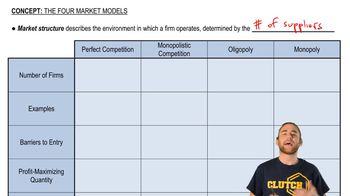
Perfect competition and monopolistic competition have many sellers; monopoly has one.
Free entry and exit in perfect and monopolistic competition; no free entry in monopoly.
Perfect competition sells identical products; monopolistic competition sells differentiated products; monopoly sells one product.
No market power in perfect competition; some in monopolistic competition; full in monopoly.
Perfect competition: horizontal; monopolistic competition and monopoly: downward sloping.
None in perfect competition and monopoly; many in monopolistic competition.