 Back
Principles of Microeconomics Midterm 1 Study Guide
 01:42


Terms in this set (31)
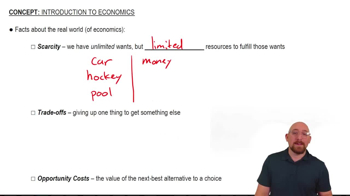
Economics is the study of how individuals and societies allocate scarce resources to satisfy unlimited wants.
Positive is what will happen, normative is what should happen.
Ex Pos- Increase minimum wage will increase labor cost for small bus
Norm- We should raise minimum wage to help low income workers
Microeconomics studies individual markets and agents; macroeconomics studies the economy as a whole.
Trade-offs occur because resources are limited, so choosing more of one thing means less of another.
Ex- Working more means more income, but less time for activities you enjoy
Opportunity cost is the value of the next best alternative foregone when making a choice.
Equilibrium is a state where economic forces such as supply and demand are balanced and no incentive exists to change behavior.
Economics uses empiricism to test theories and models through observation and data.
Models simplify reality to explain economic behavior; theories are broader explanations based on models.
Mean is the average; median is the middle value, useful for understanding data distributions.
Causation means one event causes another; correlation means two events occur together but not necessarily cause each other.
Optimization can be done by total value (maximizing overall benefit) or marginal analysis (comparing incremental benefits and costs).
Total- Total time studying and the score you got
Marginal Analysis- How many points you actually gained by studying
A market is any arrangement that allows buyers and sellers to exchange goods and services.
The law of demand states that, ceteris paribus, quantity demanded decreases as price increases.
A demand schedule lists quantities demanded at different prices; a demand curve graphs this relationship.
Qd is quantity demanded at a specific price; D is the entire demand relationship at all prices.
Individual demand is one consumer's demand; market demand is the sum of all individual demands.
The law of supply states that, ceteris paribus, quantity supplied increases as price increases.
A supply schedule lists quantities supplied at different prices; a supply curve graphs this relationship.
Qs is quantity supplied at a specific price; S is the entire supply relationship at all prices.
Individual supply is one producer's supply; market supply is the sum of all individual supplies.
Market equilibrium occurs where quantity demanded equals quantity supplied at a certain price.
Surplus occurs when quantity supplied exceeds quantity demanded; shortage occurs when quantity demanded exceeds quantity supplied.
Shifts in supply or demand curves cause changes in equilibrium price and quantity.
Consumers maximize utility subject to their budget constraint and prices.
Preferences, budget, and prices guide consumer choices.
The BCL shows all combinations of goods a consumer can afford given income and prices.
Consumer equilibrium occurs when the marginal utility per dollar spent is equal across all goods.
Maximum satisfaction for a budget
Consumer surplus is the difference between what consumers are willing to pay and what they actually pay.
Price elasticity of demand measures responsiveness of quantity demanded to price changes.
How much will consumers repsond to a change in prices
The law of diminishing returns states that adding more of one input, holding others fixed, eventually yields smaller increases in output.
ATC is average total cost, TC is total cost, and AVC is average variable cost.