Skip to main content
Personal Health
My Course
Learn
Exam Prep
AI Tutor
Study Guides
Flashcards
Try the app
My Course
Learn
Exam Prep
AI Tutor
Study Guides
Flashcards
Try the app
Back
Alcohol Overview quiz
You can tap to flip the card.
What type of alcohol is found in alcoholic beverages?
You can tap to flip the card.
👆
What type of alcohol is found in alcoholic beverages?
Ethanol is the type of alcohol found in alcoholic beverages.
Track progress
Control buttons has been changed to "navigation" mode.
1/20
Related flashcards
Related practice
Recommended videos
Alcohol Overview definitions
Alcohol Overview
15 Terms
Alcohol Overview
Ch.8 Alcohol and Tobacco
5 problems
Topic
Nicole
Alcohol and Health
Ch.8 Alcohol and Tobacco
5 problems
Topic
Laura
Ch.8 Alcohol and Tobacco
4 topics
12 problems
Chapter
Nicole
Guided course
1:46
Introduction Example 1
83
views
2
rank
Guided course
2:04
Introduction Concept 1
103
views
1
rank
Guided course
3:37
Alcohol Absorption & Metabolism Concept 2
114
views
Terms in this set (20)
Hide definitions
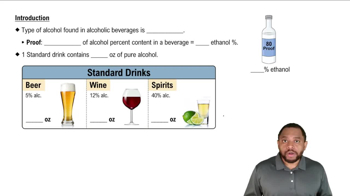
What type of alcohol is found in alcoholic beverages?
Ethanol is the type of alcohol found in alcoholic beverages.
How is 'proof' of an alcoholic beverage calculated?
Proof is equal to two times the ethanol percentage in the beverage.
If a bottle is labeled as 80 proof, what is its ethanol percentage?
An 80 proof bottle contains 40% ethanol.
How many ounces of pure alcohol are in a standard drink?
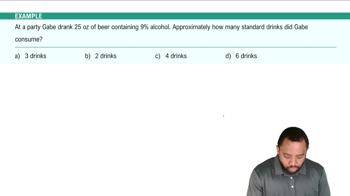
A standard drink contains about 0.6 ounces of pure alcohol.
What is the typical alcohol percentage and volume for a standard beer?
A standard beer is about 5% alcohol and 12 ounces in volume.
What is the typical alcohol percentage and volume for a standard glass of wine?
A standard glass of wine is about 12% alcohol and 5 ounces in volume.
What is the typical alcohol percentage and volume for a standard serving of spirits?
A standard serving of spirits is about 40% alcohol and 1.5 ounces in volume.
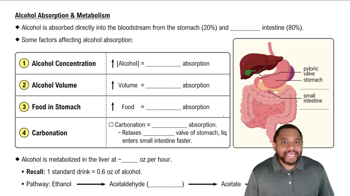
Where does most alcohol absorption occur in the digestive tract?
Most alcohol absorption occurs in the small intestine, accounting for about 80%.
What percentage of alcohol is absorbed in the stomach?
About 20% of alcohol is absorbed in the stomach.
Name four factors that affect alcohol absorption.
Alcohol concentration, alcohol volume, food in the stomach, and carbonation affect absorption.
How does higher alcohol concentration affect absorption rate?
Higher alcohol concentration leads to faster absorption.
How does greater alcohol volume affect absorption rate?
Greater alcohol volume slows down absorption.
How does food in the stomach affect alcohol absorption?
More food in the stomach slows down alcohol absorption.
How does carbonation affect alcohol absorption?
Carbonation speeds up alcohol absorption by relaxing the pyloric valve.
At what rate does the liver metabolize alcohol?
The liver metabolizes alcohol at about 0.5 ounces per hour.
What is the pathway for alcohol metabolism in the liver?
Ethanol is broken down into acetaldehyde, then acetate, and finally into carbon dioxide and water.
What does BAC stand for and what does it measure?
BAC stands for blood alcohol concentration and measures the ratio of alcohol to total blood volume.
What is the legal BAC limit for driving in the U.S.?
The legal BAC limit for driving in the U.S. is 0.08%.
List four factors that affect blood alcohol concentration.
Weight, water content, body fat, and sex affect blood alcohol concentration.
Why do women generally have higher BAC than men after drinking the same amount?
Women tend to have less muscle mass, more body fat, and weigh less, leading to higher BAC than men.
 BackBack
 1:46
1:46