Skip to main content
Personal Health
My Course
Learn
Exam Prep
AI Tutor
Study Guides
Flashcards
Try the app
My Course
Learn
Exam Prep
AI Tutor
Study Guides
Flashcards
Try the app
Back
Body Composition definitions
You can tap to flip the card.
Body Composition
You can tap to flip the card.
👆
Body Composition
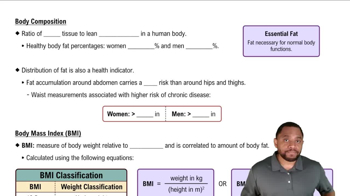
Ratio of fat tissue to lean muscle, used to assess health and risk for chronic diseases.
Track progress
Control buttons has been changed to "navigation" mode.
1/15
Related flashcards
Related practice
Recommended videos
Body Composition quiz
Body Composition
20 Terms
Body Composition quiz #1
Body Composition
10 Terms
Body Composition
Ch.6 Weight Management
5 problems
Topic
Brendan
Factors Affecting Weight
Ch.6 Weight Management
5 problems
Topic
Ally
Ch.6 Weight Management - Part 1 of 2
5 topics
9 problems
Chapter
Laura
Ch.6 Weight Management - Part 2 of 2
1 topic
2 problems
Chapter
Laura
Guided course
1:18
Body Composition Example 1
74
views
3
rank
Guided course
4:44
Body Composition Concept 1
103
views
1
rank
Guided course
2:09
Clinical Methods Concept 2
78
views
2
rank
Terms in this set (15)
Hide definitions
Body Composition
Ratio of fat tissue to lean muscle, used to assess health and risk for chronic diseases.
Essential Fats
Lipids required for normal biological functions, supporting processes like hormone production and cell structure.
Fat Distribution
Pattern of adipose tissue placement, with abdominal accumulation linked to higher disease risk.
Body Fat Percentage
Proportion of total body mass comprised of fat, with healthy ranges differing by sex.
Waist Measurement
Circumference around the abdomen, used to estimate risk for hypertension, diabetes, and cardiovascular disease.
Chronic Disease
Long-term health conditions, such as cardiovascular disease and diabetes, often associated with excess body fat.
Body Mass Index
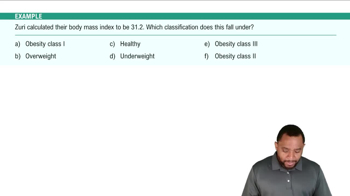
Numerical value derived from weight and height, used to classify body composition categories.
Obesity
Classification indicating excessive body fat, divided into three levels based on BMI values.
Underweight
BMI category below 18.5, indicating insufficient body mass relative to height.
Bioelectric Impedance Analysis
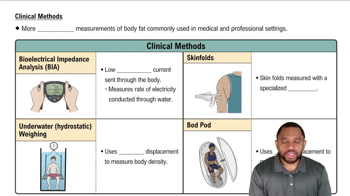
Clinical method using electrical current to estimate body fat by measuring conductivity through water.
Skinfold Measurement
Technique using calipers to assess subcutaneous fat thickness for body composition estimation.
Hydrostatic Weighing
Procedure using water displacement to determine body density and fat-to-lean muscle ratio.
Bod Pod
Device employing air displacement to measure body density for accurate body composition analysis.
Muscle Mass
Amount of lean tissue in the body, influencing weight and affecting BMI interpretation.
Reference Tool
Instrument or method, such as BMI, used for preliminary assessment rather than definitive diagnosis.
 BackBack


 1:18
1:18