Pearson+ LogoPearson+ Logo

Body's Defense System quiz Flashcards

Back
Body's Defense System quiz
Control buttons has been changed to "navigation" mode.
1/20
  • What are the two main types of barriers in the body's defense system?

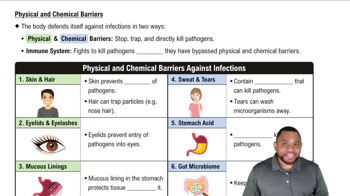
    The two main types are physical barriers (like skin and hair) and chemical barriers (like sweat and stomach acid).
  • How does skin function as a physical barrier?

    Skin prevents the entry of pathogens into the body.
  • What role do nose hairs play in the body's defense?

    Nose hairs trap particles and pathogens, preventing them from entering the body.
  • How do eyelids and eyelashes protect the eyes?

    Eyelids and eyelashes prevent pathogens from entering the eyes.
  • What is the function of mucus linings in the body?

    Mucus linings protect tissues by trapping pathogens and preventing them from reaching underlying tissues.
  • How do sweat and tears act as chemical barriers?

    Sweat and tears contain chemicals that kill pathogens, and tears can also wash away microorganisms.
  • What is the role of stomach acid in the defense system?

    Stomach acid is very acidic and directly kills many types of pathogens that enter the stomach.
  • How does the gut microbiome contribute to the body's defense?

    The gut microbiome keeps invaders in check by consuming food and releasing chemicals that kill pathogens.
  • What happens if physical and chemical barriers fail to stop pathogens?

    If these barriers fail, the immune system activates to fight and kill the pathogens.
  • What are the two branches of the immune system?

    The two branches are the innate immune system and the adaptive immune system.
  • How is the innate immune system described?

    The innate immune system is a nonspecific, immediate defense present from birth that targets anything foreign.
  • Which cells are involved in the innate immune response?

    Neutrophils, macrophages (phagocytes), and natural killer cells are involved in the innate immune response.
  • What is the main function of phagocytes like macrophages?

    Phagocytes engulf and digest pathogens and dead or damaged cells.
  • How do natural killer cells function in immunity?

    Natural killer cells rapidly identify and destroy infected cells.
  • What distinguishes the adaptive immune system from the innate immune system?

    The adaptive immune system is specialized, develops over time, and targets specific pathogens.
  • Which cells are central to the adaptive immune response?

    B cells (beta cells) and T cells (lymphocytes) are central to the adaptive immune response.
  • What is the role of helper T cells in the adaptive immune system?

    Helper T cells trigger the production of B cells and killer T cells.
  • How do B cells (beta cells) help fight infections?

    B cells produce antibodies that attach to antigens on pathogens to neutralize or mark them for destruction.
  • What is the function of killer T cells?

    Killer T cells attack and destroy infected cells.
  • What are memory cells and why are they important?

    Memory cells are B and T cells that remain after an infection to provide faster immunity if the same pathogen invades again.