Skip to main content
Personal Health
My Course
Learn
Exam Prep
AI Tutor
Study Guides
Flashcards
Try the app
My Course
Learn
Exam Prep
AI Tutor
Study Guides
Flashcards
Try the app
Back
Cancer Risk Factors definitions
You can tap to flip the card.
Carcinogen
You can tap to flip the card.
👆
Carcinogen
A substance or agent that increases the likelihood of abnormal cell growth, often leading to the development of malignant tumors.
Track progress
Control buttons has been changed to "navigation" mode.
1/15
Related flashcards
Related practice
Recommended videos
Cancer Risk Factors quiz
Cancer Risk Factors
20 Terms
Cancer Risk Factors
Ch.10 Major Diseases
4 problems
Topic
Laura
Types of Cancers
Ch.10 Major Diseases
5 problems
Topic
Ally
Ch.10 Major Diseases - Part 1 of 2
4 topics
9 problems
Chapter
Brendan
Ch.10 Major Diseases - Part 2 of 2
3 topics
8 problems
Chapter
Nicole
Guided course
3:30
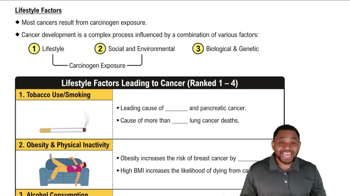
Lifestyle Factors Concept 1
80
views
Guided course
1:33
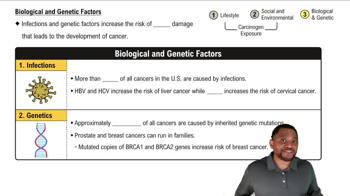
Biological and Genetic Factors Concept 3
65
views
Guided course
2:23
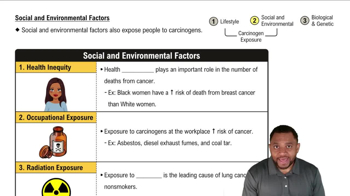
Social and Environmental Factors Concept 2
55
views
Terms in this set (15)
Hide definitions
Carcinogen
A substance or agent that increases the likelihood of abnormal cell growth, often leading to the development of malignant tumors.
Obesity
A condition marked by excess body fat that raises the risk of certain cancers, especially breast cancer, due to hormonal influences on tissues.
Tobacco
A product whose use is the primary cause of lung and pancreatic cancers, responsible for the majority of lung cancer deaths.
Alcohol
A beverage classified as a carcinogen, linked to increased risk of multiple cancers, including breast and colon, with no safe consumption level.
Acrylamide
A chemical formed in starchy foods cooked at high temperatures, considered a probable human carcinogen under ongoing research.
Asbestos
A mineral fiber found in some workplaces, exposure to which significantly raises the risk of developing cancer over time.
Radon
A naturally occurring radioactive gas, exposure to which is a leading cause of lung cancer in nonsmokers, often detected in homes.
UV Radiation
Invisible rays from the sun that damage skin cells, making them the main cause of most skin cancers when protection is lacking.
Health Inequity
A social condition where disparities in access and outcomes lead to higher cancer mortality rates among certain population groups.
Occupational Exposure
Contact with harmful substances at work, such as diesel fumes or coal tar, that increases the risk of developing cancer.
HPV
A virus that raises the risk of cervical cancer, responsible for a significant portion of infection-related cancer cases.
BRCA1
A gene whose mutated form greatly increases the likelihood of developing breast cancer, often identified through genetic testing.
BRCA2
A gene variant associated with a higher risk of breast cancer, inherited and detectable through specialized tests.
DNA Damage
Alterations in genetic material that can result from infections or inherited mutations, leading to abnormal cell growth and cancer.
Adipose Tissue
Body fat that is sensitive to hormonal changes, contributing to increased cancer risk in overweight individuals.
 BackBack



 3:30
3:30