Skip to main content
Personal Health
My Course
Learn
Exam Prep
AI Tutor
Study Guides
Flashcards
Try the app
My Course
Learn
Exam Prep
AI Tutor
Study Guides
Flashcards
Try the app
Back
Communication definitions
You can tap to flip the card.
Communication
You can tap to flip the card.
👆
Communication
Essential process for forming and maintaining healthy relationships, involving sharing, listening, and interpreting messages.
Track progress
Control buttons has been changed to "navigation" mode.
1/15
Related flashcards
Related practice
Recommended videos
Communication quiz
Communication
20 Terms
Communication quiz #1
Communication
10 Terms
Communication
Ch.4 Relationships and Communication
5 problems
Topic
Brendan
Partnerships and Singlehood
Ch.4 Relationships and Communication
5 problems
Topic
Nicole
Ch.4 Relationships and Communication
4 topics
12 problems
Chapter
Ally
Guided course
1:37
Nonverbal Communication Example 3
59
views
1
rank
Guided course
2:34
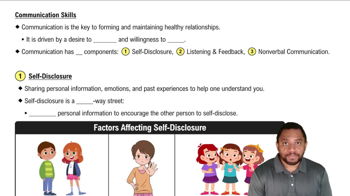
Communication Skills Concept 1
98
views
1
rank
Guided course
2:17
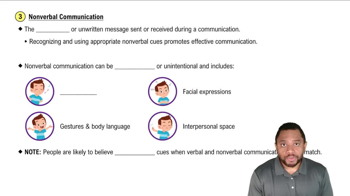
Nonverbal Communication Concept 3
94
views
1
rank
Terms in this set (15)
Hide definitions
Communication
Essential process for forming and maintaining healthy relationships, involving sharing, listening, and interpreting messages.
Self-Disclosure
Sharing personal experiences, emotions, and information to foster mutual understanding and encourage openness.
Listening
Active engagement with another's message, enhancing relationships and enabling accurate interpretation of meaning.
Feedback
Response or reaction indicating a message was received, helping clarify understanding and strengthen connections.
Nonverbal Communication
Unspoken or unwritten cues, such as facial expressions and gestures, that convey meaning beyond words.
Active Listening
Fully attentive engagement, showing understanding and providing thoughtful responses to the speaker.
Selective Listening
Focusing only on parts of a message that align with personal interests or beliefs, often missing full context.
Passive Listening
Minimal attention to a message, often resulting in automatic or superficial responses without true understanding.
Facial Expressions
Visible emotional signals that help convey feelings and reactions, often reinforcing or contradicting spoken words.
Gestures
Physical movements, such as hand signals, that express emotions or intentions without verbal communication.
Body Language
Posture and movement patterns that communicate attitudes, emotions, and intentions nonverbally.
Tone
Quality or emotion in a voice that influences how a message is interpreted, such as happiness or aggression.
Interpersonal Space
Physical distance maintained between individuals, reflecting comfort, boundaries, or emotional states.
Confidentiality
Protection of shared personal information, crucial for building trust and encouraging open communication.
Emotional Intelligence
Ability to recognize, understand, and manage emotions in oneself and others, enhancing relationship quality.
 BackBack


 1:37
1:37