Skip to main content
Personal Health
My Course
Learn
Exam Prep
AI Tutor
Study Guides
Flashcards
Try the app
My Course
Learn
Exam Prep
AI Tutor
Study Guides
Flashcards
Try the app
Back
Communication quiz
You can tap to flip the card.
What are the three main components of effective communication in intimate relationships?
You can tap to flip the card.
👆
What are the three main components of effective communication in intimate relationships?
The three main components are self-disclosure, listening and feedback, and nonverbal communication.
Track progress
Control buttons has been changed to "navigation" mode.
1/20
Related flashcards
Related practice
Recommended videos
Communication definitions
Communication
15 Terms
Communication quiz #1
Communication
10 Terms
Communication
Ch.4 Relationships and Communication
5 problems
Topic
Brendan
Partnerships and Singlehood
Ch.4 Relationships and Communication
5 problems
Topic
Nicole
Ch.4 Relationships and Communication
4 topics
12 problems
Chapter
Ally
Guided course
1:37
Nonverbal Communication Example 3
59
views
1
rank
Guided course
2:34
Communication Skills Concept 1
98
views
1
rank
Guided course
2:17
Nonverbal Communication Concept 3
94
views
1
rank
Terms in this set (20)
Hide definitions
What are the three main components of effective communication in intimate relationships?
The three main components are self-disclosure, listening and feedback, and nonverbal communication.
What is self-disclosure in the context of communication?
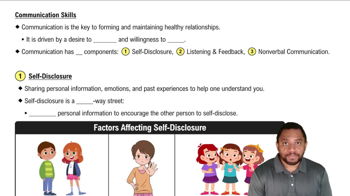
Self-disclosure is sharing personal information, emotions, and past experiences to help others understand you better.
Why is self-disclosure considered a two-way street?
Because sharing personal information encourages the other person to also self-disclose, fostering mutual understanding.
What is a potential negative aspect of self-disclosure?
Fear of rejection or previous violations of confidentiality can make people hesitant to self-disclose.
How can previous violations of confidentiality affect future self-disclosure?
They can create distrust and serve as roadblocks to sharing personal information in future relationships.
What role does listening play in effective communication?
Listening is vital for interpreting what the other person says and enhances relationships through active engagement.
What is feedback in communication?
Feedback is the response or reaction given by the receiver to the sender, indicating the message was received.
What is active listening?
Active listening involves fully engaging with the speaker, understanding their message, and responding thoughtfully.
How does selective listening differ from active listening?
Selective listening involves only paying attention to parts of the message that support one's existing beliefs.
What characterizes passive listening?
Passive listening is when someone hears the message but does not provide meaningful feedback or engagement.
Name two strategies to improve listening skills.
Avoid distractions and ask for clarification if something is unclear.
Why is it important to avoid interrupting during a conversation?
Interrupting prevents the speaker from fully expressing themselves and shows a lack of active listening.
What is nonverbal communication?
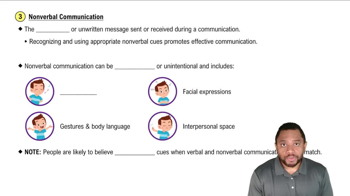
Nonverbal communication is the unspoken or unwritten message sent or received during communication, such as facial expressions or gestures.
Give two examples of nonverbal communication.
Examples include tone of voice and facial expressions.
How can tone of voice affect communication?
Tone can convey emotions such as aggression, happiness, or sadness, influencing how the message is received.
Why is it important for verbal and nonverbal communication to match?
If they don't match, it can cause confusion and make people doubt the sincerity of the message.
What can gestures and body language communicate?
They can express emotions like happiness or anger without using words.
How does interpersonal space function in nonverbal communication?
Interpersonal space can signal a need for distance or comfort, especially during moments of conflict.
What is the impact of nonverbal cues on communication?
Nonverbal cues can reinforce or contradict verbal messages, affecting how the message is interpreted.
How does mastering communication components benefit relationships?
It promotes emotional intelligence and strengthens interpersonal connections, leading to more fulfilling relationships.
 BackBack


 1:37
1:37