Pearson+ LogoPearson+ Logo

Determinants of Health quiz #1 Flashcards

Back
Determinants of Health quiz #1
Control buttons has been changed to "navigation" mode.
1/10
  • Is it true that healthy fitness routines are only possible in certain living environments?

    No, healthy fitness routines are possible in various living environments, but the built environment can influence access to resources like parks and recreational areas, which can make maintaining fitness routines easier or more challenging.
  • According to the biopsychosocial model, what determines health?

    The biopsychosocial model states that health is determined by a combination of biological factors (such as genetics and age), psychological factors (such as individual behavior), and social factors (such as economic stability, education, and community).
  • What most directly impacts a person's physical health?

    Individual behavior, including physical activity, diet, alcohol use, and tobacco smoking, most directly impacts a person's physical health, as these are modifiable determinants that can be changed to improve health outcomes.
  • What are the five main factors that contribute to good health?

    The five main factors that contribute to good health are individual behavior, biology and genetics, social determinants (such as economic stability and education), access to quality health services, and effective policy-making.
  • Do everyday lifestyle choices affect your physical fitness?

    Yes, everyday lifestyle choices such as engaging in regular physical activity, eating a healthy diet, avoiding excessive alcohol use, and not smoking significantly affect physical fitness and overall health.
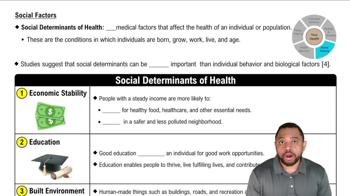
  • How do social institutions affect health?

    Social institutions, such as schools, workplaces, and healthcare systems, affect health by shaping access to education, economic opportunities, health services, and community support, all of which influence health outcomes.
  • How is social inequality related to health?

    Social inequality is related to health because individuals with lower economic stability, less education, and limited access to health services often experience poorer health outcomes compared to those with greater resources and opportunities.
  • How many annual deaths in the US are attributed to tobacco smoking, including secondhand smoke?

    Tobacco smoking is responsible for about 480,000 deaths annually among smokers, with an additional 41,000 deaths from secondhand smoke. This highlights its significant negative impact on public health.
  • What is a food desert and how does it affect health outcomes?

    A food desert is an urban area where the nearest grocery store is at least one mile away for most residents, limiting access to fresh fruits and vegetables. This increases reliance on processed foods and raises the risk of all-cause mortality.
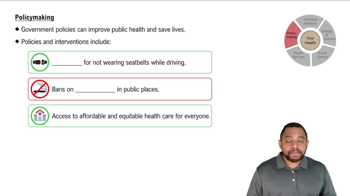
  • How have government policies contributed to improved public health and safety?

    Government policies such as seat belt laws and bans on smoking in public places have reduced deaths from accidents and exposure to secondhand smoke. These interventions demonstrate how policy-making can save lives and improve health outcomes.