Skip to main content
Personal Health
My Course
Learn
Exam Prep
AI Tutor
Study Guides
Flashcards
Try the app
My Course
Learn
Exam Prep
AI Tutor
Study Guides
Flashcards
Try the app
Back
Drug Interactions quiz
You can tap to flip the card.
What is a drug interaction?
You can tap to flip the card.
👆
What is a drug interaction?
A drug interaction occurs when two or more substances taken together affect each other's effectiveness or side effects.
Track progress
Control buttons has been changed to "navigation" mode.
1/20
Related flashcards
Related practice
Recommended videos
Drug Interactions definitions
Drug Interactions
15 Terms
Drug Interactions
Ch.9 Drugs
2 problems
Topic
Laura
Treatment and Recovery
Ch.9 Drugs
5 problems
Topic
Laura
Ch.9 Drugs
5 topics
13 problems
Chapter
Laura
Guided course
1:13
Drug Interactions Example 1
79
views
Guided course
2:32
Drug Interactions Concept 1
74
views
2
rank
Guided course
2:03
Drug Interactions Concept 2
78
views
1
rank
Terms in this set (20)
Hide definitions
What is a drug interaction?
A drug interaction occurs when two or more substances taken together affect each other's effectiveness or side effects.
What are the possible outcomes of drug interactions?
Drug interactions can have either positive or negative outcomes.
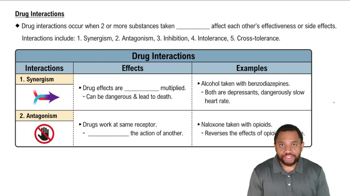
What is synergism in drug interactions?
Synergism is when the combined effects of drugs are amplified, making the overall effect much greater.
Give an example of a dangerous synergistic drug interaction.
Mixing alcohol and benzodiazepines is a dangerous synergistic interaction that can decrease breathing and heart rate, possibly leading to death.
What is antagonism in drug interactions?
Antagonism occurs when one drug blocks or reverses the action of another drug at the same receptor.
How does naloxone interact with opioids?
Naloxone acts as an antagonist by overriding opioids in the system and reversing opioid overdose effects.
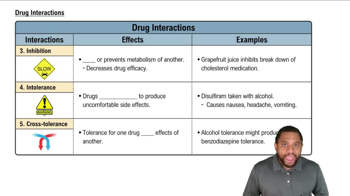
What is inhibition in the context of drug interactions?
Inhibition is when one substance slows, decreases, or prevents the metabolism of another drug, reducing its efficacy.
How does grapefruit juice affect cholesterol medication?
Grapefruit juice inhibits the breakdown of cholesterol medication, making the medication less effective.
What is intolerance in drug interactions?
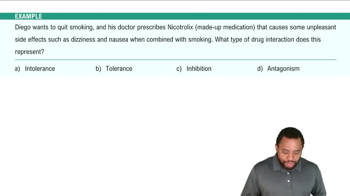
Intolerance occurs when drugs combine to produce uncomfortable or unpleasant side effects.
What happens when disulfiram is taken with alcohol?
Disulfiram causes unpleasant symptoms like nausea, headache, and vomiting when alcohol is consumed, discouraging drinking.
Can intolerance in drug interactions ever be positive?
Yes, intolerance can be positive, such as when disulfiram helps prevent alcohol consumption in alcoholics.
What is cross tolerance?
Cross tolerance is when tolerance to one drug decreases the effects of another drug.
Give an example of cross tolerance.
Tolerance to alcohol can produce tolerance to benzodiazepines, reducing their effects.
Why is it important to understand drug interactions?
Understanding drug interactions is crucial for safe drug use, as interactions can be beneficial or deadly.
What can happen if depressants are mixed together?
Mixing depressants like alcohol and benzodiazepines can dangerously decrease breathing and heart rate, possibly causing death.
Do all antagonistic drug interactions have positive effects?
No, not all antagonistic interactions are positive; some may have negative effects depending on the drugs involved.
What determines whether a drug interaction is positive or negative?
The outcome depends on the drugs involved and how they interact with each other in the body.
What is the main risk of not understanding drug categories when mixing drugs?
Not understanding drug categories can lead to dangerous or even fatal interactions.
What is the effect of inhibition on drug efficacy?
Inhibition decreases a drug's efficacy by slowing or preventing its metabolism.
Why might someone intentionally use a drug interaction like intolerance?
Someone might use intolerance, such as with disulfiram and alcohol, to discourage harmful behaviors like drinking.
 BackBack
 1:13
1:13