Skip to main content
Personal Health
My Course
Learn
Exam Prep
AI Tutor
Study Guides
Flashcards
Try the app
My Course
Learn
Exam Prep
AI Tutor
Study Guides
Flashcards
Try the app
Back
Essential Micronutrients quiz
You can tap to flip the card.
What are the two main categories of micronutrients?
You can tap to flip the card.
👆
What are the two main categories of micronutrients?
Micronutrients are divided into vitamins and minerals.
Track progress
Control buttons has been changed to "navigation" mode.
1/20
Related flashcards
Related practice
Recommended videos
Essential Micronutrients definitions
Essential Micronutrients
15 Terms
Essential Micronutrients
Ch.5 Nutrition Basics
5 problems
Topic
Nicole
Antioxidants
Ch.5 Nutrition Basics
1 problem
Topic
Laura
Ch.5 Nutrition Basics - Part 1 of 2
4 topics
8 problems
Chapter
Nicole
Ch.5 Nutrition Basics - Part 2 of 2
3 topics
8 problems
Chapter
Nicole
Guided course
1:26
Minerals Concept 2
67
views
1
rank
Guided course
2:29
Vitamins Concept 1
74
views
1
rank
Guided course
1:09
Essential Micronutrients Example 1
64
views
1
rank
Terms in this set (20)
Hide definitions
What are the two main categories of micronutrients?
Micronutrients are divided into vitamins and minerals.
How are vitamins classified?
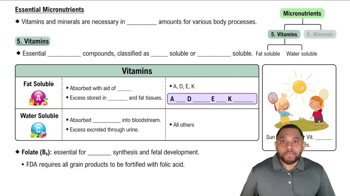
Vitamins are classified as either fat-soluble or water-soluble.
Which vitamins are fat-soluble?
Vitamins A, D, E, and K are fat-soluble.
What is a memory tool to remember the fat-soluble vitamins?
The phrase 'All Dogs Eat Kibble' helps remember vitamins A, D, E, and K.
Where are excess fat-soluble vitamins stored in the body?
Excess fat-soluble vitamins are stored in the liver and fat tissues.
How are water-soluble vitamins absorbed and excreted?
Water-soluble vitamins are absorbed directly into the bloodstream and excess is excreted in urine.
What is the benefit of sun exposure related to micronutrients?
Sun exposure helps the body synthesize vitamin D.
What is folate also known as?
Folate is also known as vitamin B9.
Why is folate important for the body?
Folate is essential for DNA synthesis and fetal development.
What birth defect can folate help prevent?
Folate helps prevent neural tube defects in fetuses.
What is the synthetic form of folate called?
The synthetic form of folate is called folic acid.
Why does the FDA require grain products to be fortified with folic acid?
Fortification helps prevent neural tube defects by ensuring adequate folate intake.
What are minerals classified as?
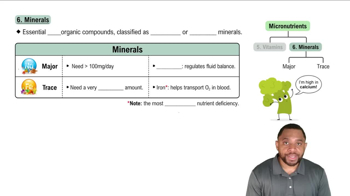
Minerals are classified as major or trace minerals.
What is the difference between major and trace minerals?
Major minerals are needed in amounts greater than 100 mg per day, while trace minerals are needed in smaller amounts.
Give an example of a major mineral and its function.
Sodium is a major mineral that helps regulate fluid balance.
Give an example of a trace mineral and its function.
Iron is a trace mineral that helps transport oxygen in the blood.
What is the most common nutrient deficiency?
Iron deficiency is the most common nutrient deficiency.
Why are minerals considered inorganic compounds?
Minerals are inorganic because they do not contain carbon.
Which vegetable is high in calcium, a major mineral?
Broccoli is high in calcium.
What are some grain products that are fortified with folic acid?
Rice, cereals, and pasta are examples of grain products fortified with folic acid.
 BackBack

 1:26
1:26