Pearson+ LogoPearson+ Logo

Mastering Your Health Behaviors quiz Flashcards

Back
Mastering Your Health Behaviors quiz
Control buttons has been changed to "navigation" mode.
1/20
  • What are the four main stages in the process of health behavior change?

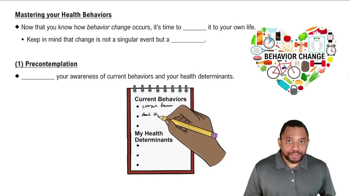
    The four stages are precontemplation, contemplation, preparation, and action.
  • What is the purpose of the precontemplation stage in behavior change?

    It increases awareness of current behaviors and health determinants, helping you identify which are modifiable.
  • How does self-efficacy influence health behavior change?

    Self-efficacy is the belief in your ability to achieve change, which empowers you to take action.
  • What does having an internal locus of control mean?

    It means believing that your decisions and actions influence the outcomes in your life.
  • Why is it important to visualize yourself achieving your health goals?

    Visualization helps you mentally prepare and motivates you to put your plans into action.
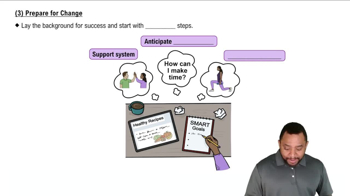
  • What role does a support system play in preparing for health behavior change?

    A support system provides encouragement and accountability, helping you reach and maintain your goals.
  • What does the 'S' in SMART goals stand for?

    The 'S' stands for Specific, meaning the goal is clearly defined.
  • How can you make a health goal measurable?

    By including criteria that allow you to track progress, such as losing a certain number of pounds or tracking daily calories.
  • Why should health goals be attainable?

    Goals should be within your physical, financial, and time capabilities to avoid setting yourself up for failure.
  • What makes a health goal realistic?

    A realistic goal aligns with your priorities, circumstances, and constraints, making it practical to achieve.
  • Why is it important for a goal to be time-bound?

    A time-bound goal has a clear deadline, which helps you stay focused and motivated.
  • Give an example of a SMART goal for improving physical fitness.

    Lose 10 pounds by March 10 by running three times a week for thirty minutes and eating a caloric deficit of 500.
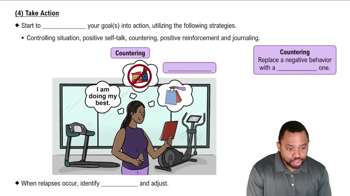
  • What is countering in the context of health behavior change?

    Countering means replacing a negative behavior or impulse with a positive one.
  • How can positive self-talk help you master your health behaviors?

    Positive self-talk boosts motivation and confidence, helping you overcome doubts and setbacks.
  • What is the benefit of journaling during the action stage?

    Journaling helps you track progress, identify triggers, and reinforce adaptive responses.
  • Why is it important to identify triggers for relapses?

    Identifying triggers allows you to adjust your strategies and minimize their effects, keeping you on track.
  • How does positive reinforcement support health behavior change?

    Positive reinforcement rewards progress, encouraging you to continue healthy behaviors.
  • What should you do when you experience a setback in your health behavior change?

    Identify the trigger for the setback and adjust your approach to minimize its impact in the future.
  • Why is behavior change described as a marathon rather than a sprint?

    Because it is a continuous process with ups and downs, requiring persistence over time.
  • How do SMART goals help in organizing a plan of action for health behavior change?

    SMART goals break down big, ambiguous ideas into specific, measurable, attainable, realistic, and time-bound steps.