Pearson+ LogoPearson+ Logo

Modes of Transmission definitions Flashcards

Back
Modes of Transmission definitions
Control buttons has been changed to "navigation" mode.
1/14
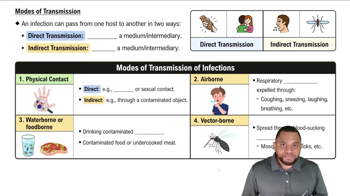
  • Direct Transmission

    Movement of infectious agents between hosts through immediate physical contact, without any intermediary.
  • Indirect Transmission

    Spread of infectious agents via a medium or intermediary, such as objects, droplets, or vectors.
  • Physical Contact

    Interaction involving skin or sexual contact, enabling transfer of infectious agents directly between individuals.
  • Contaminated Object

    Item carrying infectious agents, facilitating indirect transmission when touched by multiple individuals.
  • Airborne Transmission

    Dispersal of infectious agents through respiratory droplets expelled by coughing, sneezing, or breathing.
  • Respiratory Droplets

    Tiny liquid particles released from the respiratory tract, serving as vehicles for infectious agents.
  • Waterborne Infection

    Illness resulting from consumption or contact with water containing infectious agents.
  • Foodborne Infection

    Disease acquired by ingesting contaminated food or undercooked meat containing infectious agents.
  • Vectorborne Infection

    Transmission of infectious agents through blood-sucking insects such as mosquitoes, fleas, or ticks.
  • Vector

    Living organism, often an insect, that carries and transfers infectious agents between hosts.
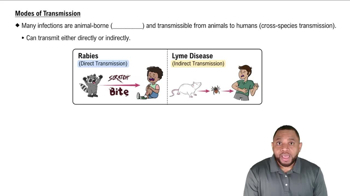
  • Zoonotic Infection

    Disease originating in animals and capable of crossing species barriers to infect humans.
  • Cross-Species Transmission

    Movement of infectious agents from animals to humans, often involving direct or indirect pathways.
  • Rabies

    Viral zoonotic disease transmitted directly from infected animals to humans through bites or scratches.
  • Lyme Disease

    Tick-borne zoonotic illness commonly contracted in wooded areas, causing significant health issues.