Skip to main content
Personal Health
My Course
Learn
Exam Prep
AI Tutor
Study Guides
Flashcards
Try the app
My Course
Learn
Exam Prep
AI Tutor
Study Guides
Flashcards
Try the app
Back
Principles of Physical Training definitions
You can tap to flip the card.
Individuality
You can tap to flip the card.
👆
Individuality
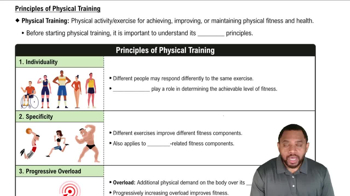
Genetic factors and personal traits influence how each person responds to physical training and fitness improvements.
Track progress
Control buttons has been changed to "navigation" mode.
1/15
Related flashcards
Related practice
Recommended videos
Principles of Physical Training quiz
Principles of Physical Training
20 Terms
Principles of Physical Training quiz #1
Principles of Physical Training
34 Terms
Principles of Physical Training
Ch.7 Exercise and Fitness
5 problems
Topic
Ally
Exercise Program
Ch.7 Exercise and Fitness
5 problems
Topic
Brendan
Ch.7 Exercise and Fitness
4 topics
12 problems
Chapter
Laura
Guided course
3:16
The FITT Principle Concept 2
112
views
Guided course
5:21
Physical Training Concept 1
105
views
1
rank
Guided course
2:02
The FITT Principle Example 2
69
views
1
rank
Terms in this set (15)
Hide definitions
Individuality
Genetic factors and personal traits influence how each person responds to physical training and fitness improvements.
Specificity
Targeted exercises develop particular fitness or skill components, depending on sport or activity requirements.
Progressive Overload
Gradually increasing physical demands enhances fitness, but excessive increases may cause injury or be ineffective.
Reversibility
Fitness gains diminish rapidly with inactivity; significant loss can occur within two months of stopping exercise.
FITT Principle
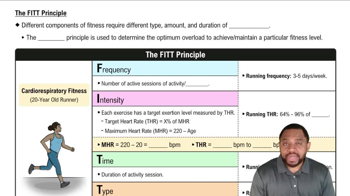
A guideline for training that considers frequency, intensity, time, and type to optimize fitness improvements.
Frequency
The number of exercise sessions performed per week, influencing overall fitness progress.
Intensity
The exertion level during exercise, often measured by heart rate, determining the effectiveness of a workout.
Time
The duration of each exercise session, which affects the extent of fitness benefits gained.
Type
The specific kind of physical activity performed, chosen to target particular health or skill-related fitness components.
Maximum Heart Rate
An estimate of the highest safe heart rate during exercise, calculated as 220 minus age.
Target Heart Rate
A heart rate range, typically 64% to 96% of maximum, used to gauge optimal exercise intensity.
Cardiorespiratory Fitness
The ability of the heart and lungs to supply oxygen efficiently during sustained physical activity.
Adaptive Thermogenesis
The body's adjustment to lower activity levels, resulting in decreased energy expenditure and fitness.
Muscle Oxygen Intake
The efficiency with which muscles absorb and utilize oxygen, which can improve with consistent training.
Skill-Related Fitness
Components of fitness such as agility, coordination, and mobility, developed through specific training for sports.
 BackBack


 3:16
3:16