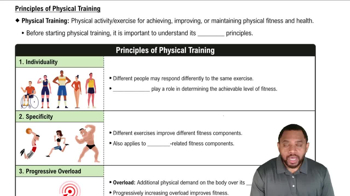
What are the four main principles of building fitness?
The four main principles of building fitness are individuality, specificity, progressive overload, and reversibility.
Explain the principle of individuality in physical training.
The principle of individuality states that different people respond differently to the same exercise due to genetic factors and other individual differences.
What does the principle of specificity mean in exercise?
The principle of specificity means that different exercises improve specific fitness components and skills, so training should be tailored to the desired outcome.
Describe the concept of progressive overload in fitness training.
Progressive overload involves gradually increasing the physical demands placed on the body to improve fitness, such as increasing weight, intensity, or duration.
What is reversibility in the context of physical training?
Reversibility refers to the loss of fitness gains when exercise is stopped, with significant reductions possible within two months of inactivity.
Is the rear deltoid row considered a back exercise?
Yes, the rear deltoid row is considered a back exercise.
What happens to muscles during resistance exercise?
During resistance exercise, muscles are subjected to increased physical demand, which can lead to strength and endurance improvements through adaptation.
Which stretching technique do experts recommend for general fitness?
Experts recommend static stretching for general fitness.
Why is cardio coasting detrimental to a fitness routine?
Cardio coasting is detrimental because it reduces the intensity of exercise, leading to less effective fitness gains.
Is plyometrics an isometric exercise technique?
No, plyometrics is not an isometric exercise technique; it involves explosive movements to improve power.
What is an example of a short-term fitness goal?
A short-term fitness goal could be increasing workout frequency or improving a specific exercise technique over a few weeks.
According to the exercise principle of balance, what should a workout include?
A balanced workout should include exercises that target all major muscle groups and fitness components.
What is ballistic stretching?
Ballistic stretching involves rapid, bouncing movements and is generally not recommended due to increased risk of injury.
What is an example of resistance exercise?
An example of resistance exercise is weightlifting.
What are the three main principles of exercise?
The three main principles of exercise are individuality, specificity, and progressive overload.
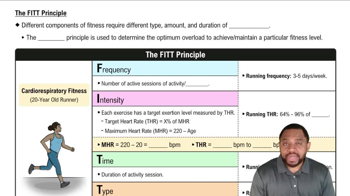
What does FITT stand for in health and fitness?
FITT stands for Frequency, Intensity, Time, and Type.
Why should a personal training plan use the FITT principles?
A personal training plan should use the FITT principles to ensure optimal overload and effective improvement in fitness.
Should everyone exercise with the same frequency?
No, exercise frequency should be individualized based on personal goals, fitness level, and other factors.
Are fitness requirements the same for individuals of all ages?
No, fitness requirements vary by age, individual needs, and health status.
List the principles of exercise.
The principles of exercise are individuality, specificity, progressive overload, and reversibility.
Are all types of exercise appropriate at any age?
No, not all types of exercise are appropriate for every age; exercise should be tailored to the individual's age and abilities.
How does a pedometer help people reach their fitness goals?
A pedometer helps people track their physical activity, set goals, and monitor progress, encouraging increased movement.
Is the hip flexor predominantly a calf stretching exercise?
No, the hip flexor stretch targets the hip muscles, not the calf.
What measures how stressful exercise is on your body?
Exercise intensity measures how stressful exercise is on your body.
Is it possible for an individual to exercise too much?
Yes, excessive exercise can lead to injury or overtraining.
In fitness, what do acute training variables determine?
Acute training variables determine the immediate response and adaptation to a specific exercise session, such as intensity, duration, and type.
What kind of exercise is part of the FITT model?
Any exercise can be part of the FITT model, as long as its frequency, intensity, time, and type are considered.
What is an adaptation from plyometric exercise?
An adaptation from plyometric exercise is increased muscular power and explosiveness.
During resistance training, which sub-variable is related to exercise type?
The sub-variable related to exercise type is the specific movement or muscle group targeted during resistance training.
Which stretching exercise is usually not recommended?
Ballistic stretching is usually not recommended due to its higher risk of injury.
Which type of exercise is mainly seen in martial arts?
Plyometric and skill-based exercises are mainly seen in martial arts.
Which energy-producing pathway is used for short, intense exercise?
The anaerobic energy pathway is used for short, intense exercise.
How long do anaerobic exercise bursts typically last?
Anaerobic exercise bursts typically last from a few seconds up to about two minutes.
Why is variety important in an exercise program?
Variety is important to prevent boredom, reduce risk of injury, and ensure balanced development of all fitness components.
 Back
Back


 3:16
3:16