Pearson+ LogoPearson+ Logo

Sexually Transmitted Diseases quiz Flashcards

Back
Sexually Transmitted Diseases quiz
Control buttons has been changed to "navigation" mode.
1/20
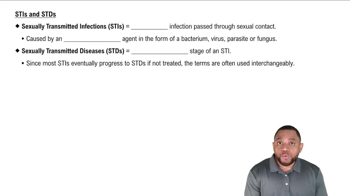
  • What is the main difference between an STI and an STD?

    An STI is the initial infection caused by a pathogen, while an STD is the symptomatic stage of that infection.
  • What are the four types of infectious agents that can cause STIs?

    STIs can be caused by bacteria, viruses, parasites, or fungi.
  • List two common symptoms of STDs.

    Common symptoms include bodily sores and abnormal discharge.
  • Why are the terms STI and STD often used interchangeably?

    Because most STIs eventually progress to STDs if untreated, and the distinction between infection and disease can be blurred.
  • What is a common symptom of STDs that affects the lymphatic system?

    Swollen lymph nodes, especially in the neck or groin, are a common symptom.
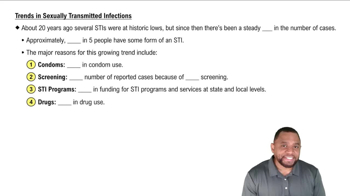
  • What trend has been observed in STI cases over the past 20 years?

    There has been a steady increase in the number of STI cases.
  • Name two factors contributing to the increase in STI cases.

    Decreased condom use and reduced funding for prevention programs are major factors.
  • Which age group accounts for more than half of all US STI cases?

    Young people aged 15 to 24 account for more than half of all cases.
  • Which racial and ethnic groups are disproportionately affected by new STI cases?

    African Americans, Hispanics, and other racial/ethnic minorities are disproportionately affected.
  • Which gender tends to have higher prevalence rates of new STI cases?

    Women tend to have higher prevalence rates of new STI cases.
  • Which STI has more cases than all other STIs combined?

    HPV (Human Papillomavirus) has more cases than all other STIs combined.
  • What is the relationship between HPV and cancer?

    HPV is linked to certain types of cancers, and reported cases often refer to cancer cases.
  • Which two STIs are more prevalent among men than women?

    Syphilis and HIV are more prevalent among men, especially due to men who have sex with men.
  • What is the most effective way to prevent STI transmission?

    Abstinence is the most effective way to prevent STI transmission.
  • What is considered a low-risk behavior for STI transmission?

    Low-risk behaviors include kissing or holding hands, as long as there are no sores or cuts.
  • How does drug use increase the risk of STI transmission?

    Drug use can impair judgment, leading to high-risk behaviors, and can also expose individuals to infections through bodily fluids.
  • What is a moderate-risk behavior for STI transmission?

    Moderate-risk behavior includes protected sex using condoms or other barriers.
  • What is a high-risk behavior for contracting an STI?

    High-risk behaviors include having unprotected sex and combining sex with drug use.
  • Why might increased screening lead to higher reported STI cases?

    Increased screening detects more cases, which raises the number of reported infections.
  • What is one reason why women may have higher reported rates of certain STIs?

    Women may have higher reported rates due to biological factors and more frequent screening.