Skip to main content
Personal Health
My Course
Learn
Exam Prep
AI Tutor
Study Guides
Flashcards
Try the app
My Course
Learn
Exam Prep
AI Tutor
Study Guides
Flashcards
Try the app
Back
Sleep Disorders definitions
You can tap to flip the card.
Insomnia
You can tap to flip the card.
👆
Insomnia
Condition marked by persistent difficulty initiating or maintaining sleep, often linked to depression, heart disease, and stress.
Track progress
Control buttons has been changed to "navigation" mode.
1/15
Related flashcards
Related practice
Recommended videos
Sleep Disorders quiz
Sleep Disorders
20 Terms
Sleep Disorders quiz #1
Sleep Disorders
10 Terms
Sleep Disorders
Ch.3 Stress Management and Sleep
5 problems
Topic
Nicole
Sleep and Health
Ch.3 Stress Management and Sleep
5 problems
Topic
Nicole
Ch.3 Stress Management and Sleep - Part 1 of 2
4 topics
12 problems
Chapter
Ally
Ch.3 Stress Management and Sleep - Part 2 of 2
3 topics
9 problems
Chapter
Nicole
Guided course
1:16
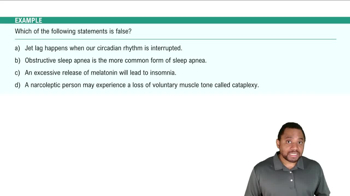
Sleep Disorders Example 1
63
views
2
rank
Guided course
2:36
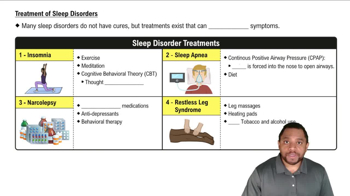
Treatment of Sleep Disorders Concept 2
96
views
2
rank
Guided course
1:44
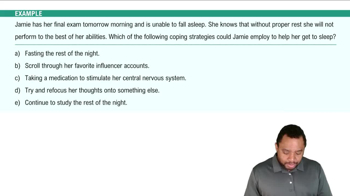
Treatment of Sleep Disorders Example 2
58
views
Terms in this set (15)
Hide definitions
Insomnia
Condition marked by persistent difficulty initiating or maintaining sleep, often linked to depression, heart disease, and stress.
Sleep Apnea
Breathing disorder during sleep with repeated pauses lasting at least ten seconds, often accompanied by loud snoring.
Obstructive Sleep Apnea
Type of sleep apnea caused by relaxed throat muscles and tongue blocking the airway, resulting in disrupted breathing.
Central Sleep Apnea
Less common form of sleep apnea involving a disconnect between brain signals and muscle movement, often related to alcohol use.
Narcolepsy
Neurological disorder affecting sleep-wake cycles, causing sudden, uncontrollable episodes of sleep and related symptoms.
Cataplexy
Sudden loss of muscle tone often triggered by strong emotions, commonly associated with narcolepsy.
Paralysis
Temporary inability to move or speak, frequently occurring during transitions between sleep and wakefulness in narcolepsy.
Hallucinations
Vivid sensory experiences that may occur during sleep-wake transitions, often linked to severe narcolepsy.
Restless Leg Syndrome
Neurological disorder causing uncomfortable sensations in the legs, leading to an urge to move and possible pain.
Cognitive Behavioral Therapy
Psychological treatment focusing on changing negative thought patterns to reduce stress and improve sleep quality.
Thought Refocusing
Technique involving replacement of negative thoughts with positive ones to lower stress and facilitate sleep.
CPAP Machine
Device delivering continuous positive airway pressure through the nose to keep airways open during sleep.
Stimulant Medications
Drugs prescribed to promote wakefulness and manage symptoms of narcolepsy by increasing alertness.
Sleep Hygiene
Set of lifestyle practices aimed at improving sleep quality and consistency, such as exercise and reduced substance use.
Antidepressants
Medications that can boost energy and help manage sleep disorders, especially narcolepsy.
 BackBack

 1:16
1:16