What is the term for a condition that results from a chronic deficiency in sleep?
Sleep deprivation occurs when there is a chronic deficiency in sleep.
What is the most serious potential consequence of sleep apnea?
The most serious potential consequence of sleep apnea is that breathing stops for at least 10 seconds, which can lead to serious health risks such as heart disease.
During which stage of sleep does sleepwalking typically occur?
Sleepwalking typically occurs during non-REM (NREM) sleep.
In which stage of sleep is sleepwalking most likely to happen?
Sleepwalking is most likely to happen during non-REM (NREM) sleep.
Sleep paralysis is most commonly associated with which sleep disorder?
Sleep paralysis is most commonly associated with narcolepsy.
Is a sleep time of 15.9 hours considered normal or abnormal for adults?
A sleep time of 15.9 hours is considered abnormal for adults, as typical adult sleep needs are much lower.
What type of medication can cause sleep driving as a side effect?
Certain sleep medications, such as sedative-hypnotics, can cause sleep driving as a side effect.
Which class of medication is known to potentially cause sleep driving?
Sedative-hypnotic medications are known to potentially cause sleep driving.
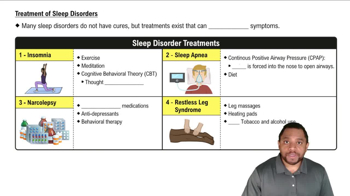
What are the two main types of sleep apnea and how do they differ?
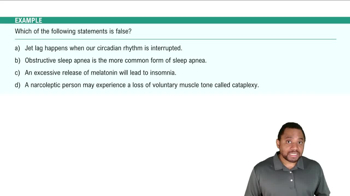
Obstructive sleep apnea is caused by relaxed throat muscles and tongue blocking the airway, while central sleep apnea results from a disconnect between the brain and muscles, often triggered by excessive alcohol consumption. Obstructive sleep apnea is more common than central sleep apnea.
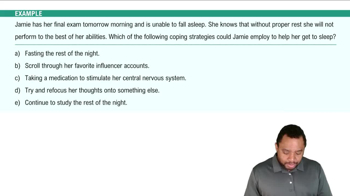
Which treatment method for insomnia involves replacing negative thoughts with positive ones to reduce stress?
Thought refocusing is a cognitive-behavioral technique used to replace negative thoughts with positive ones, thereby lowering stress. This method can help individuals fall asleep by alleviating symptoms of insomnia.
 Back
Back

 1:16
1:16