The Chain of Infection definitions Flashcards
BackThe Chain of Infection definitions
You can tap to flip the card.
Control buttons has been changed to "navigation" mode.
1/15
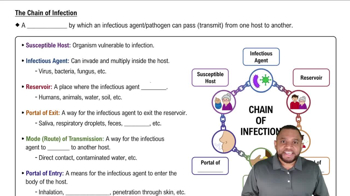
Infectious Agent
A microorganism capable of invading and multiplying within a host, potentially causing disease.Pathogen
A disease-causing organism such as a bacterium, virus, or fungus that can be transmitted between hosts.Susceptible Host
An organism with vulnerability to infection, often due to a weakened or compromised immune system.Reservoir
A location where a microorganism lives and multiplies, which can include humans, animals, or environmental sources.Portal of Exit
A pathway allowing a microorganism to leave its reservoir, such as through saliva, droplets, feces, or blood.Mode of Transmission
A method by which a microorganism passes from one host to another, including direct contact or contaminated surfaces.Portal of Entry
A route through which a microorganism enters a new host, such as inhalation, ingestion, or skin penetration.Handwashing
A hygiene practice that disrupts the spread of microorganisms by removing them from the skin surface.Direct Contact
A transmission route involving physical touch between hosts, facilitating the spread of microorganisms.Respiratory Droplets
Tiny particles expelled during coughing or sneezing that can carry microorganisms to new hosts.Immunocompromised
A state in which an individual's immune system is weakened, increasing vulnerability to infections.Disease Prevention
Strategies and actions aimed at interrupting the transmission of microorganisms to reduce infection risk.Contaminated Water
A medium that can harbor and transmit microorganisms, serving as a route for infection.Skin Penetration
A process by which microorganisms enter a host through breaks or openings in the skin.Inhalation
A portal of entry where microorganisms are taken into the body through breathing.