Pearson+ LogoPearson+ Logo

The Chain of Infection quiz Flashcards

Back
The Chain of Infection quiz
Control buttons has been changed to "navigation" mode.
1/20
  • What is the chain of infection?

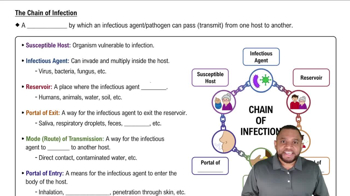
    The chain of infection is the process by which an infectious agent passes from one host to another through specific steps.
  • Who is considered a susceptible host in the chain of infection?

    A susceptible host is an organism vulnerable to infection, such as someone with a weakened immune system.
  • What types of organisms can serve as infectious agents?

    Infectious agents can be viruses, bacteria, or fungi.
  • What is a reservoir in the chain of infection?

    A reservoir is a place where the infectious agent lives, which can be a human, animal, water, or soil.
  • What is the portal of exit?

    The portal of exit is the way an infectious agent leaves the reservoir, such as through saliva, respiratory droplets, feces, or blood.
  • What is meant by mode of transmission?

    Mode of transmission is the way an infectious agent passes to another host, such as through direct contact or contaminated water.
  • What is the portal of entry?

    The portal of entry is how the infectious agent enters the body of a new host, such as by inhalation, ingestion, or skin penetration.
  • How can the chain of infection be interrupted?

    The chain can be interrupted by breaking any link, such as practicing handwashing or avoiding direct contact.
  • Why are older adults often more susceptible to infections?

    Older adults may have weakened or compromised immune systems, making them more vulnerable to infections.
  • Give an example of a non-human reservoir.

    Water or soil can serve as non-human reservoirs for infectious agents.
  • How can respiratory droplets serve as a portal of exit?

    Respiratory droplets can carry infectious agents out of the body when a person coughs or sneezes.
  • What is direct contact transmission?

    Direct contact transmission occurs when an infectious agent is passed by physical touch between individuals.
  • How can contaminated objects contribute to infection transmission?

    Contaminated objects, like doorknobs, can transfer infectious agents to new hosts when touched.
  • What are some ways infectious agents can enter a new host?

    They can enter through inhalation, ingestion, or penetration of the skin.
  • Why is handwashing important in preventing infection?

    Handwashing removes infectious agents from the skin, breaking the chain of infection.
  • What does the memory tool 'suspected infection requires extra routes of entry' help you remember?

    It helps recall the steps: susceptible host, infectious agent, reservoir, portal of exit, mode of transmission, and portal of entry.
  • How does avoiding close contact with sick individuals help prevent infection?

    It reduces the chance of infectious agents being transmitted to a susceptible host.
  • What role does the immune system play in susceptibility to infection?

    A strong immune system can resist infection, while a weakened one increases susceptibility.
  • Why is understanding the chain of infection important for public health?

    It helps in controlling infectious diseases and reducing health risks, especially for vulnerable populations.
  • What is the significance of breaking the chain of infection at any point?

    Breaking the chain at any point can prevent the spread of infection to others.