Skip to main content
Personal Health
My Course
Learn
Exam Prep
AI Tutor
Study Guides
Flashcards
Try the app
My Course
Learn
Exam Prep
AI Tutor
Study Guides
Flashcards
Try the app
Back
The Process of Sleep definitions
You can tap to flip the card.
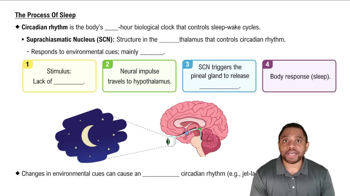
Circadian Rhythm
You can tap to flip the card.
👆
Circadian Rhythm
Twenty-four hour internal clock regulating sleep-wake cycles, influenced by environmental cues like light.
Track progress
Control buttons has been changed to "navigation" mode.
1/15
Related flashcards
Related practice
Recommended videos
The Process of Sleep quiz
The Process of Sleep
20 Terms
The Process of Sleep quiz #1
The Process of Sleep
33 Terms
The Process of Sleep
Ch.3 Stress Management and Sleep
5 problems
Topic
Ally
Sleep and Health
Ch.3 Stress Management and Sleep
5 problems
Topic
Nicole
Ch.3 Stress Management and Sleep - Part 1 of 2
4 topics
12 problems
Chapter
Ally
Ch.3 Stress Management and Sleep - Part 2 of 2
3 topics
9 problems
Chapter
Nicole
Guided course
3:34
Stages of Sleep Concept 2
80
views
3
rank
Guided course
2:13
The Process Of Sleep Concept 1
89
views
1
rank
Guided course
3:38
Stages of Sleep Example 2
80
views
3
rank
Terms in this set (15)
Hide definitions
Circadian Rhythm
Twenty-four hour internal clock regulating sleep-wake cycles, influenced by environmental cues like light.
Suprachiasmatic Nucleus
Cluster of cells in the hypothalamus acting as the master controller of the body's biological clock.
Hypothalamus
Brain region housing the master clock and receiving signals about light to regulate sleep processes.
Melatonin
Hormone released by the pineal gland in response to darkness, signaling the body to initiate sleep.
Pineal Gland
Small endocrine gland responsible for releasing the sleep hormone in response to signals from the brain.
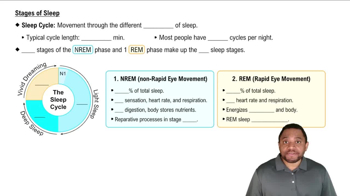
Non-REM Sleep
Three-stage phase of sleep marked by decreased heart rate, respiration, and increased tissue repair.
REM Sleep
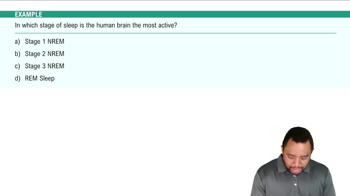
Sleep stage characterized by vivid dreaming, increased brain activity, and temporary paralysis.
Sleep Cycle
Repeated progression through sleep stages, typically lasting 90-110 minutes and occurring multiple times nightly.
Deep Sleep
Stage within non-REM sleep crucial for physical restoration, muscle repair, and growth processes.
Sleep Debt
Cumulative difference between required and actual sleep, leading to impaired repair and increased fatigue.
Environmental Cues
External factors, especially light, that influence the timing and quality of sleep through biological signaling.
Sleep Patterns
Distribution of non-REM and REM stages throughout the night, affecting dreaming and restorative processes.
Paralysis
Temporary immobilization during REM sleep preventing physical movement despite heightened brain activity.
Vivid Dreaming
Intense mental experiences occurring predominantly during REM sleep, often remembered upon waking.
Regenerative Processes
Bodily functions during deep sleep that restore tissues, support growth, and maintain overall health.
 BackBack

 3:34
3:34