Skip to main content
Personal Health
My Course
Learn
Exam Prep
AI Tutor
Study Guides
Flashcards
Try the app
My Course
Learn
Exam Prep
AI Tutor
Study Guides
Flashcards
Try the app
Back
The Process of Sleep quiz
You can tap to flip the card.
What is the Circadian Rhythm?
You can tap to flip the card.
👆
What is the Circadian Rhythm?
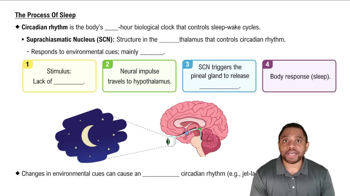
The Circadian Rhythm is the body's 24-hour biological clock that controls sleep-wake cycles.
Track progress
Control buttons has been changed to "navigation" mode.
1/20
Related flashcards
Related practice
Recommended videos
The Process of Sleep definitions
The Process of Sleep
15 Terms
The Process of Sleep quiz #1
The Process of Sleep
33 Terms
The Process of Sleep
Ch.3 Stress Management and Sleep
5 problems
Topic
Ally
Sleep and Health
Ch.3 Stress Management and Sleep
5 problems
Topic
Nicole
Ch.3 Stress Management and Sleep - Part 1 of 2
4 topics
12 problems
Chapter
Ally
Ch.3 Stress Management and Sleep - Part 2 of 2
3 topics
9 problems
Chapter
Nicole
Guided course
3:34
Stages of Sleep Concept 2
80
views
3
rank
Guided course
2:13
The Process Of Sleep Concept 1
89
views
1
rank
Guided course
3:38
Stages of Sleep Example 2
80
views
3
rank
Terms in this set (20)
Hide definitions
What is the Circadian Rhythm?
The Circadian Rhythm is the body's 24-hour biological clock that controls sleep-wake cycles.
Which brain structure controls the Circadian Rhythm?
The Suprachiasmatic Nucleus (SCN) in the hypothalamus controls the Circadian Rhythm.
What environmental cue primarily triggers the sleep process?
The lack of light is the main environmental cue that signals the body to prepare for sleep.
Which gland releases melatonin in response to darkness?
The pineal gland releases melatonin when it receives signals indicating darkness.
What is the role of melatonin in sleep?
Melatonin is a hormone that signals the body to fall asleep.
How can changes in environmental cues disrupt the Circadian Rhythm?
Changes like jet lag or night shift work can cause irregular Circadian Rhythms by altering normal sleep patterns.
How long does a typical sleep cycle last?
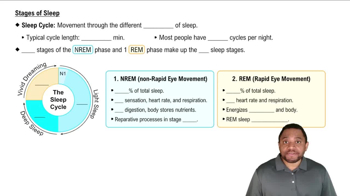
A typical sleep cycle lasts between 90 and 110 minutes.
How many sleep cycles do most people experience per night?
Most people experience four to five sleep cycles per night.
How many stages are there in a sleep cycle?
There are four stages: three non-REM stages and one REM stage.
What percentage of sleep is spent in non-REM stages?
About 75% of sleep is spent in non-REM stages.
What happens to heart rate and respiration during non-REM sleep?
Heart rate and respiration decrease during non-REM sleep.
What happens to digestion and nutrient storage during non-REM sleep?
Digestion and nutrient storage increase during non-REM sleep.
Which sleep stage is associated with body repair and growth?
Stage N3, or deep sleep, is when the body repairs tissue and supports growth.
What percentage of sleep is spent in REM sleep?
About 25% of sleep is spent in REM sleep.
What happens to heart rate and respiration during REM sleep?
Heart rate and respiration increase during REM sleep.
Why does paralysis occur during REM sleep?
Paralysis prevents the body from moving during vivid dreaming, protecting the sleeper from harm.
When is non-REM sleep most prominent during the night?
Non-REM sleep is longer in the first half of the night.
When is REM sleep most prominent during the night?
REM sleep increases and is more prominent in the second half of the night.
What is sleep debt?
Sleep debt is the difference between the amount of sleep needed and the amount actually obtained.
What are the effects of missing one to two hours of sleep?
Missing one to two hours of sleep can cause loss of deep and REM sleep, leading to tiredness and reduced body repair.
 BackBack

 3:34
3:34