Is all neural activity during sleep directed toward dreaming?
No, not all neural activity during sleep is directed toward dreaming. Dreaming primarily occurs during REM sleep, while other stages involve restorative processes and decreased neural activity.
What is NREM sleep?
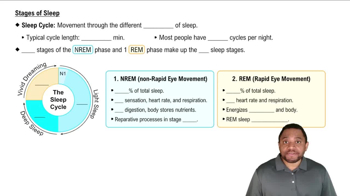
NREM sleep is a period of sleep characterized by non-rapid eye movement, decreased heart rate and respiration, increased digestion and nutrient storage, and restorative processes.
What is REM sleep associated with?
REM sleep is associated with vivid dreaming, increased heart rate and respiration, paralysis of major muscle groups, and energizing the brain and body.
What are the characteristics of stage 1 sleep?
Stage 1 sleep is a light sleep phase where the body begins to relax, and the transition from wakefulness to sleep occurs.
What are the main features of REM sleep?
REM sleep is characterized by rapid eye movements, vivid dreaming, increased heart rate and respiration, and paralysis of major muscle groups.
During which stage of sleep do sleep spindles occur?
Sleep spindles occur during stage 2 of NREM sleep.
Which type of brain wave is characteristic of stage 1 sleep?
Stage 1 sleep is characterized by theta waves.
How are the stages of sleep delineated?
The stages of sleep are delineated by changes in brain wave patterns, physiological activity, and depth of sleep.
Why is REM sleep called paradoxical sleep?
REM sleep is called paradoxical sleep because the brain is highly active, similar to wakefulness, but the body experiences paralysis.
In which stage of sleep do sleep spindles occur?
Sleep spindles occur in stage 2 of NREM sleep.
What stage of sleep do sleep spindles appear?
Sleep spindles appear in stage 2 of NREM sleep.
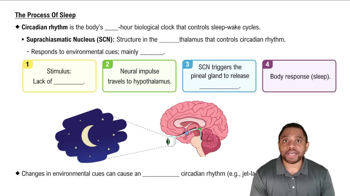
Which gland helps regulate the chemicals that control sleep?
The pineal gland helps regulate sleep by releasing melatonin.
What is the role of the pineal gland in sleep?
The pineal gland releases melatonin in response to darkness, signaling the body to prepare for sleep.
What part of the brain controls sleep and arousal?
The suprachiasmatic nucleus in the hypothalamus controls sleep and arousal by regulating the circadian rhythm.
In which phase of sleep does dreaming most commonly occur?
Dreaming most commonly occurs during REM sleep.
What does REM stand for in sleep?
REM stands for Rapid Eye Movement.
What is the deepest stage of sleep?
The deepest stage of sleep is stage 3 of NREM sleep, also known as deep sleep.
What is paradoxical sleep?
Paradoxical sleep refers to REM sleep, where the brain is active but the body is paralyzed.
What part of the brain is responsible for controlling sleep?
The suprachiasmatic nucleus in the hypothalamus is responsible for controlling sleep.
During which part of sleep do you dream?
Dreaming primarily occurs during REM sleep.
What is the role of the pons in sleep and arousal?
The pons is involved in regulating REM sleep and arousal by influencing neural activity during sleep cycles.
Sleep is a universal biological need. True or false?
True. Sleep is a universal biological need essential for physical and mental health.
Do the adrenal glands control internal sleep and waking cycles?
No, the adrenal glands do not control sleep and waking cycles; the suprachiasmatic nucleus and pineal gland are primarily responsible.
What does it mean if someone prefers to stay up late and sleep in?
Preferring to stay up late and sleep in may indicate a different circadian rhythm or sleep pattern, such as being a 'night owl.'
At what time is the body most susceptible to sleep?
The body is most susceptible to sleep during nighttime, when environmental light decreases and melatonin is released.
What is true of NREM sleep?
NREM sleep is characterized by decreased heart rate and respiration, increased digestion, restorative processes, and comprises about 75% of total sleep.
How is sleep debt defined?
Sleep debt is the difference between the amount of sleep one needs and the amount one actually gets, and it can accumulate over time.
What is the relationship between tiredness and sleep?
Tiredness is a signal that the body needs sleep, similar to how curiosity motivates exploration.
How does the circadian rhythm regulate sleep?
The circadian rhythm regulates sleep by responding to environmental cues like light, signaling the release of melatonin to induce sleep.
What happens to sleep patterns throughout the night?
NREM sleep predominates in the first half of the night, while REM sleep increases in the second half.
What are the four stages of sleep?
The four stages of sleep are three NREM stages (N1, N2, N3) and one REM stage.
How many sleep cycles does a typical person experience per night?
A typical person experiences four to five sleep cycles per night, each lasting 90-110 minutes.
How many hours are there in a week minus sleep?
To calculate hours in a week minus sleep, subtract the total hours spent sleeping from 168 (the number of hours in a week).
 Back
Back

 3:34
3:34